Key Takeaways
- AI infrastructure drives half of U.S. GDP despite public anxiety.
- Texas elected a governor who pledged to pause new data center construction.
- Volatile post-election trading suggests markets may have bottomed.
The Importance of AI & AI Sentiment
Some estimates suggest that data center construction, power facilities, and telecommunications infrastructure supporting the AI build-out now comprise roughly half of U.S. GDP. In other words, without AI, the U.S. economy and stock market would be in a world of hurt. At the same time, numerous polls suggest that most Americans are staunchly against AI. For instance, Gallup found that 79% of Americans expect AI to reduce U.S. jobs over the next decade. Meanwhile, a recent Reuters poll found that 77% of Americans worry that AI-driven data centers will raise electricity costs.
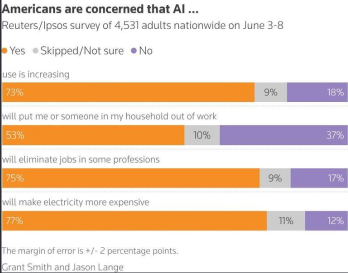
Image Source: Reuters
The Impact of Midterm Elections on the AI Trade
Last night, a lot was at stake for AI companies during the U.S. midterm elections. For instance, for the first time in years, the normally right-leaning state of Texas was up for grabs for Democrats. Currently, roughly a third of U.S. data center gigawatts are located in Texas. For AI data center companies in Texas, their worst nightmare came true. Democratic candidate Gina Hinojosa beat incumbent Greg Abobot to win the Texas gubernatorial race. Hinojosa has repeatedly called for a halt to all new data center construction in the state.
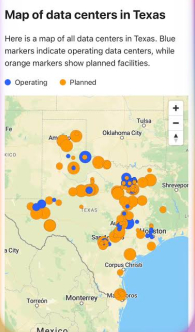
Image Source: Zacks Investment Research
Markets are a Discounting Mechanism
Undoubtedly, last night was a terrible night for AI companies, particularly in the data center space. Markets tend to discount news in advance. For several weeks, stocks have been selling off as polls and betting markets suggested a Democratic “blue wave” was all but guaranteed. That said, savvy investors understand that Wall Street is the master manipulator. As soon as it became clear that a blue wave was a reality, stocks fell 2%, then rallied 3%. The volatile action signals a classic capitulatory move. Investors sold the rumor and bought the news. Often, such news failures mark significant market bottoms. Although the election was an adverse outcome for the industry, it provided much-needed certainty for Wall Street investors.
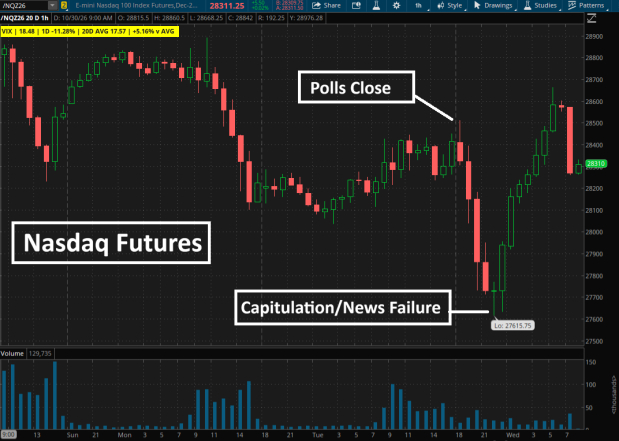
Image Source: Zacks Investment Research
Bottom Line
While political shifts and widespread public skepticism pose real headwinds for data center expansion, the market’s resilient reaction to the Texas election demonstrates how quickly bad news can be priced in. With policy certainty and investor capitulation, stocks may have just bottomed.



 View the Zacks #1 Rank List


Image: Shutterstock
Sell the Rumor, Buy the News: The AI Policy Bottom
Key Takeaways
The Importance of AI & AI Sentiment
Some estimates suggest that data center construction, power facilities, and telecommunications infrastructure supporting the AI build-out now comprise roughly half of U.S. GDP. In other words, without AI, the U.S. economy and stock market would be in a world of hurt. At the same time, numerous polls suggest that most Americans are staunchly against AI. For instance, Gallup found that 79% of Americans expect AI to reduce U.S. jobs over the next decade. Meanwhile, a recent Reuters poll found that 77% of Americans worry that AI-driven data centers will raise electricity costs.
Image Source: Reuters
The Impact of Midterm Elections on the AI Trade
Last night, a lot was at stake for AI companies during the U.S. midterm elections. For instance, for the first time in years, the normally right-leaning state of Texas was up for grabs for Democrats. Currently, roughly a third of U.S. data center gigawatts are located in Texas. For AI data center companies in Texas, their worst nightmare came true. Democratic candidate Gina Hinojosa beat incumbent Greg Abobot to win the Texas gubernatorial race. Hinojosa has repeatedly called for a halt to all new data center construction in the state.
Image Source: Zacks Investment Research
Markets are a Discounting Mechanism
Undoubtedly, last night was a terrible night for AI companies, particularly in the data center space. Markets tend to discount news in advance. For several weeks, stocks have been selling off as polls and betting markets suggested a Democratic “blue wave” was all but guaranteed. That said, savvy investors understand that Wall Street is the master manipulator. As soon as it became clear that a blue wave was a reality, stocks fell 2%, then rallied 3%. The volatile action signals a classic capitulatory move. Investors sold the rumor and bought the news. Often, such news failures mark significant market bottoms. Although the election was an adverse outcome for the industry, it provided much-needed certainty for Wall Street investors.
Image Source: Zacks Investment Research
Bottom Line
While political shifts and widespread public skepticism pose real headwinds for data center expansion, the market’s resilient reaction to the Texas election demonstrates how quickly bad news can be priced in. With policy certainty and investor capitulation, stocks may have just bottomed.