We use cookies to understand how you use our site and to improve your experience.
This includes personalizing content and advertising.
By pressing "Accept All" or closing out of this banner, you consent to the use of all cookies and similar technologies and the sharing of information they collect with third parties.
You can reject marketing cookies by pressing "Deny Optional," but we still use essential, performance, and functional cookies.
In addition, whether you "Accept All," Deny Optional," click the X or otherwise continue to use the site, you accept our Privacy Policy and Terms of Service, revised from time to time.
You are being directed to ZacksTrade, a division of LBMZ Securities and licensed broker-dealer. ZacksTrade and Zacks.com are separate companies. The web link between the two companies is not a solicitation or offer to invest in a particular security or type of security. ZacksTrade does not endorse or adopt any particular investment strategy, any analyst opinion/rating/report or any approach to evaluating individual securities.
If you wish to go to ZacksTrade, click OK. If you do not, click Cancel.
QBTS Soars 168% in 2025: Should You Buy for 2026 or Wait for Pullback?
Read MoreHide Full Article
Key Takeaways
QBTS jumps 167.8% YTD as rising demand and real-world workloads push quantum tech deeper into commercial use.
D-Wave sees more multi-year commitments, renewals and a solid pipeline, signaling predictable revenues.
QBTS advances its annealing roadmap with more qubits, better connectivity and improved hybrid tools.
As 2025 draws to a close, investors looking for the next frontier of exponential value creation should be turning their attention to pure-play quantum computing companies. D-Wave Quantum (QBTS - Free Report) stands out as one of the most compelling choices. Its third-quarter 2025 earnings performance made one thing clear: quantum technology is moving from theory into real business use, with paying customers, real-world applications and growing revenues. D-Wave’s strong pipeline, rising demand for its annealing systems and progress toward its next-generation Advantage2 system show that the company is moving along a growth path similar to early-stage NVIDIA (NVDA - Free Report) or Palantir (PLTR - Free Report) .
This is the kind of moment when early investors often see the biggest long-term gains, before the rest of the market catches on. As we head into 2026, it is a great time for investors to learn about QBTS and consider getting in at the early phase of its journey, when the upside potential is at its highest.
YTD Stock Comparison
p> Image Source: Zacks Investment Research
Year to date, shares of D-Wave have rallied 167.8%, outperforming the broader industry, sector and the S&P 500’s 5.9%, 26.6% and 18.1% growth, respectively. During this period, the company’s direct peers like Rigetti Computing (RGTI - Free Report) and IonQ (IONQ - Free Report) gained 56.4% and 12.3%, respectively.
Expanding Commercial Adoption
QBTS’ core growth driver is accelerating commercial adoption of its annealing quantum platform, which is now delivering measurable value across logistics, manufacturing, financial services and defense. The third-quarter 2025 performance highlighted a significant rise in production-grade workloads, with many customers moving from exploratory proofs-of-concept (POCs) to multi-year commitments. Strong renewal rates, an expanding enterprise pipeline and recurring usage from long-term customers signal a shift from experimentation to predictable revenues. With its systems already deployed in real-world operations, D-Wave remains the only pure-play quantum company with commercial-scale annealing, which positions it for accelerating demand within this niche space.
Strategic Technology Roadmap
The second major growth driver for D-Wave is its strong technology roadmap. The company has made steady progress on its next generation of annealing systems, which will offer more qubits, better connectivity and improved coherence. These upgrades will let customers solve bigger, more complex problems that have real commercial value. D-Wave is also improving its hybrid solvers, API tools and cloud access, making it easier for enterprises to start using and scale quantum workloads. Because the roadmap is tightly aligned with customer demand across optimization, machine learning and materials research, each technical advance feeds directly into revenue potential. With constant hardware advancements supported by strong software and integration tools, D-Wave remains the most commercially advanced player in annealing and is best positioned to deliver real business impact in the near term.
Stumbling Block
Despite its surging revenues, growing customer base and increasingly validated technology, QBTS still faces one clear stumbling block. Operating leverage remains elusive, with high operating expenses driving elevated adjusted EBITDA losses and masking progress on the commercial front. While system sales and QCaaS capacity have expanded meaningfully, the company’s cost structure—particularly R&D intensity tied to simultaneous annealing and gate-model development—continues to outpace near-term revenue scale, preventing the business from showing a visible path to sustainable profitability.
D-Wave Quantum trading below its 50-day moving average but above its 200-day moving average signals short-term weakness within a still-intact long-term uptrend. For investors, this means that though near-term momentum has cooled, the stock’s broader trend remains positive, showing ongoing institutional support.
50- and 200-Day SMAs
Image Source: Zacks Investment Research
Wait for a Better Opportunity
D-Wave’s long-term story is compelling, marked by rapid commercial adoption, a differentiated annealing platform and a technology roadmap that could unlock substantial future value. The stock’s current setup suggests that investors may benefit from exercising patience. Despite rising customer traction, QBTS still lacks operating leverage, with costs climbing faster than revenues and shares trading below key technical levels. Until margins stabilize or the stock reclaims momentum, investors may be better served waiting for a cleaner entry point into this promising quantum play. D-Wave currently carries a Zacks Rank #3 (Hold). You can see the complete list of today’s Zacks #1 Rank (Strong Buy) stocks here.



 View the Zacks #1 Rank List

Image: Bigstock
QBTS Soars 168% in 2025: Should You Buy for 2026 or Wait for Pullback?
Key Takeaways
As 2025 draws to a close, investors looking for the next frontier of exponential value creation should be turning their attention to pure-play quantum computing companies. D-Wave Quantum (QBTS - Free Report) stands out as one of the most compelling choices. Its third-quarter 2025 earnings performance made one thing clear: quantum technology is moving from theory into real business use, with paying customers, real-world applications and growing revenues. D-Wave’s strong pipeline, rising demand for its annealing systems and progress toward its next-generation Advantage2 system show that the company is moving along a growth path similar to early-stage NVIDIA (NVDA - Free Report) or Palantir (PLTR - Free Report) .
This is the kind of moment when early investors often see the biggest long-term gains, before the rest of the market catches on. As we head into 2026, it is a great time for investors to learn about QBTS and consider getting in at the early phase of its journey, when the upside potential is at its highest.
YTD Stock Comparison
p>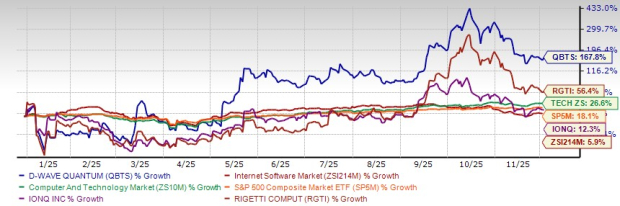
Image Source: Zacks Investment Research
Year to date, shares of D-Wave have rallied 167.8%, outperforming the broader industry, sector and the S&P 500’s 5.9%, 26.6% and 18.1% growth, respectively. During this period, the company’s direct peers like Rigetti Computing (RGTI - Free Report) and IonQ (IONQ - Free Report) gained 56.4% and 12.3%, respectively.
Expanding Commercial Adoption
QBTS’ core growth driver is accelerating commercial adoption of its annealing quantum platform, which is now delivering measurable value across logistics, manufacturing, financial services and defense. The third-quarter 2025 performance highlighted a significant rise in production-grade workloads, with many customers moving from exploratory proofs-of-concept (POCs) to multi-year commitments. Strong renewal rates, an expanding enterprise pipeline and recurring usage from long-term customers signal a shift from experimentation to predictable revenues. With its systems already deployed in real-world operations, D-Wave remains the only pure-play quantum company with commercial-scale annealing, which positions it for accelerating demand within this niche space.
Strategic Technology Roadmap
The second major growth driver for D-Wave is its strong technology roadmap. The company has made steady progress on its next generation of annealing systems, which will offer more qubits, better connectivity and improved coherence. These upgrades will let customers solve bigger, more complex problems that have real commercial value. D-Wave is also improving its hybrid solvers, API tools and cloud access, making it easier for enterprises to start using and scale quantum workloads. Because the roadmap is tightly aligned with customer demand across optimization, machine learning and materials research, each technical advance feeds directly into revenue potential. With constant hardware advancements supported by strong software and integration tools, D-Wave remains the most commercially advanced player in annealing and is best positioned to deliver real business impact in the near term.
Stumbling Block
Despite its surging revenues, growing customer base and increasingly validated technology, QBTS still faces one clear stumbling block. Operating leverage remains elusive, with high operating expenses driving elevated adjusted EBITDA losses and masking progress on the commercial front. While system sales and QCaaS capacity have expanded meaningfully, the company’s cost structure—particularly R&D intensity tied to simultaneous annealing and gate-model development—continues to outpace near-term revenue scale, preventing the business from showing a visible path to sustainable profitability.
D-Wave Quantum Stock Trades Below 50-Day and Above 200-Day Moving Averages
D-Wave Quantum trading below its 50-day moving average but above its 200-day moving average signals short-term weakness within a still-intact long-term uptrend. For investors, this means that though near-term momentum has cooled, the stock’s broader trend remains positive, showing ongoing institutional support.
50- and 200-Day SMAs
Image Source: Zacks Investment Research
Wait for a Better Opportunity
D-Wave’s long-term story is compelling, marked by rapid commercial adoption, a differentiated annealing platform and a technology roadmap that could unlock substantial future value. The stock’s current setup suggests that investors may benefit from exercising patience. Despite rising customer traction, QBTS still lacks operating leverage, with costs climbing faster than revenues and shares trading below key technical levels. Until margins stabilize or the stock reclaims momentum, investors may be better served waiting for a cleaner entry point into this promising quantum play. D-Wave currently carries a Zacks Rank #3 (Hold). You can see the complete list of today’s Zacks #1 Rank (Strong Buy) stocks here.