We use cookies to understand how you use our site and to improve your experience.
This includes personalizing content and advertising.
By pressing "Accept All" or closing out of this banner, you consent to the use of all cookies and similar technologies and the sharing of information they collect with third parties.
You can reject marketing cookies by pressing "Deny Optional," but we still use essential, performance, and functional cookies.
In addition, whether you "Accept All," Deny Optional," click the X or otherwise continue to use the site, you accept our Privacy Policy and Terms of Service, revised from time to time.
You are being directed to ZacksTrade, a division of LBMZ Securities and licensed broker-dealer. ZacksTrade and Zacks.com are separate companies. The web link between the two companies is not a solicitation or offer to invest in a particular security or type of security. ZacksTrade does not endorse or adopt any particular investment strategy, any analyst opinion/rating/report or any approach to evaluating individual securities.
If you wish to go to ZacksTrade, click OK. If you do not, click Cancel.
KKR's Expanding AUM Base: What it Signals About Growth Strategy
Read MoreHide Full Article
Key Takeaways
KKR's AUM grew from $252B in 2020 to $758B in Q1 2026, reflecting an 18% CAGR.
KKR expanded into credit, infrastructure and insurance to diversify fee-generating growth.
KKR targets $1T in AUM by 2030, supported by acquisitions and private wealth expansion.
KKR & Co. Inc.’s (KKR - Free Report) $758 billion in assets under management (“AUM”) in the first quarter of 2026 highlights its transformation into a scaled, diversified global investment platform. Its AUM is spread across Credit & Liquid Strategies, Private Equity and Real Assets, showing that growth is no longer dependent on traditional private equity alone. This broad mix gives KKR multiple channels to raise capital, deploy funds and generate management fees across different market cycles.
In its May 2026 Investor Presentation, KKR noted that AUM has grown rapidly. Its AUM witnessed a compound annual growth rate (“CAGR”) of 18% from 2010 to first-quarter 2026. Meanwhile, management fees rose at a CAGR of 26% from 2020 to first quarter 2026. These figures suggest that KKR’s scale is translating into recurring earnings power, not just larger asset totals.
AUM Growth Trend
Image Source: KKR & Co.
KKR is diversifying across infrastructure, real estate, private credit, asset-based finance and insurance-linked investments to drive AUM growth toward its $1 trillion target by 2030. The acquisition of Arctos Partners expanded KKR’s reach across private markets, while its insurance platform, Global Atlantic and private wealth push further strengthen long-term growth prospects.
Private credit concerns may moderately slow KKR’s near-term AUM growth amid weaker investor sentiment and rising sector redemptions. However, KKR’s diversified AUM base, recurring fee streams, acquisitions and expanded distribution support its long-term growth strategy. AUM growth should remain key to the earnings trajectory, with projections to rise 23.5% over the next three to five years, above the industry’s 6.03% average.
AUM Performance of KKR’s Peers
Apollo Global Management’s (APO - Free Report) AUM witnessed a CAGR of 19.6% over the past three years (2022-2025), with the rising trend continuing in the first quarter of 2026. The increase in Apollo’s AUM is primarily driven by growth in its retirement services client assets, subscriptions across the platform and new financing facilities.
The acquisition of Bridge Investment Group Holding nearly doubled Apollo’s real estate AUM to more than $110 billion. By 2029, Apollo expects the total AUM to reach $1.5 trillion by scaling its private equity business.
Similarly, Blackstone Inc. (BX - Free Report) has been witnessing a rise in its AUM balance. Over the past five years (2020-2025), total AUM and fee-earning AUM have recorded a CAGR of 15.6% and 14.4%, respectively.
Blackstone’s robust AUM base supports the long-term earnings growth by providing a larger pool of fee-generating capital across its private equity, real estate, credit and infrastructure platforms.
KKR Price Performance & Zacks Rank
The company’s shares have gained 2.8% in the past three months compared with the industry’s 2.4% rise.



 View the Zacks #1 Rank List
Image: Bigstock
KKR's Expanding AUM Base: What it Signals About Growth Strategy
Key Takeaways
KKR & Co. Inc.’s (KKR - Free Report) $758 billion in assets under management (“AUM”) in the first quarter of 2026 highlights its transformation into a scaled, diversified global investment platform. Its AUM is spread across Credit & Liquid Strategies, Private Equity and Real Assets, showing that growth is no longer dependent on traditional private equity alone. This broad mix gives KKR multiple channels to raise capital, deploy funds and generate management fees across different market cycles.
In its May 2026 Investor Presentation, KKR noted that AUM has grown rapidly. Its AUM witnessed a compound annual growth rate (“CAGR”) of 18% from 2010 to first-quarter 2026. Meanwhile, management fees rose at a CAGR of 26% from 2020 to first quarter 2026. These figures suggest that KKR’s scale is translating into recurring earnings power, not just larger asset totals.
AUM Growth Trend
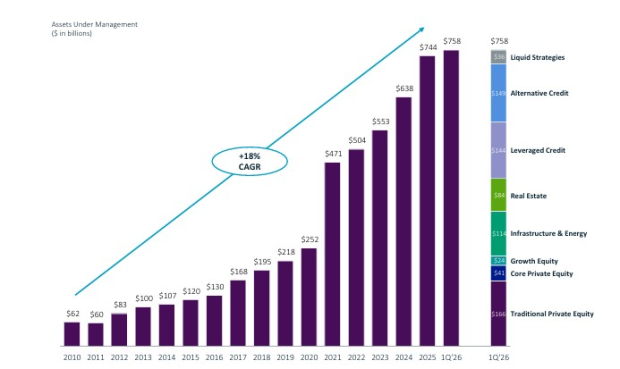
Image Source: KKR & Co.
KKR is diversifying across infrastructure, real estate, private credit, asset-based finance and insurance-linked investments to drive AUM growth toward its $1 trillion target by 2030. The acquisition of Arctos Partners expanded KKR’s reach across private markets, while its insurance platform, Global Atlantic and private wealth push further strengthen long-term growth prospects.
Private credit concerns may moderately slow KKR’s near-term AUM growth amid weaker investor sentiment and rising sector redemptions. However, KKR’s diversified AUM base, recurring fee streams, acquisitions and expanded distribution support its long-term growth strategy. AUM growth should remain key to the earnings trajectory, with projections to rise 23.5% over the next three to five years, above the industry’s 6.03% average.
AUM Performance of KKR’s Peers
Apollo Global Management’s (APO - Free Report) AUM witnessed a CAGR of 19.6% over the past three years (2022-2025), with the rising trend continuing in the first quarter of 2026. The increase in Apollo’s AUM is primarily driven by growth in its retirement services client assets, subscriptions across the platform and new financing facilities.
The acquisition of Bridge Investment Group Holding nearly doubled Apollo’s real estate AUM to more than $110 billion. By 2029, Apollo expects the total AUM to reach $1.5 trillion by scaling its private equity business.
Similarly, Blackstone Inc. (BX - Free Report) has been witnessing a rise in its AUM balance. Over the past five years (2020-2025), total AUM and fee-earning AUM have recorded a CAGR of 15.6% and 14.4%, respectively.
Blackstone’s robust AUM base supports the long-term earnings growth by providing a larger pool of fee-generating capital across its private equity, real estate, credit and infrastructure platforms.
KKR Price Performance & Zacks Rank
The company’s shares have gained 2.8% in the past three months compared with the industry’s 2.4% rise.
Price Performance
Image Source: Zacks Investment Research
Currently, KKR carries a Zacks Rank #4 (Sell).
You can see the complete list of today’s Zacks #1 Rank (Strong Buy) stocks here.