We use cookies to understand how you use our site and to improve your experience.
This includes personalizing content and advertising.
By pressing "Accept All" or closing out of this banner, you consent to the use of all cookies and similar technologies and the sharing of information they collect with third parties.
You can reject marketing cookies by pressing "Deny Optional," but we still use essential, performance, and functional cookies.
In addition, whether you "Accept All," Deny Optional," click the X or otherwise continue to use the site, you accept our Privacy Policy and Terms of Service, revised from time to time.
You are being directed to ZacksTrade, a division of LBMZ Securities and licensed broker-dealer. ZacksTrade and Zacks.com are separate companies. The web link between the two companies is not a solicitation or offer to invest in a particular security or type of security. ZacksTrade does not endorse or adopt any particular investment strategy, any analyst opinion/rating/report or any approach to evaluating individual securities.
If you wish to go to ZacksTrade, click OK. If you do not, click Cancel.
Can INTC's AI Inference Advancements Strengthen Its Growth Prospects?
Read MoreHide Full Article
Key Takeaways
Intel Xeon 6980P delivers 2.4x higher Llama 3.1 8B Server throughput versus MLPerf v6.0.
INTC expands Xeon 6 participation to five processor models, lifting CPU inference results to 35.
Arc Pro B70 GPU systems post higher Server and Offline performance across demanding AI workloads.
Intel Corporation (INTC - Free Report) has advanced artificial intelligence (AI) inference capabilities with its latest MLPerf Inference v6.1 results, showing performance gains across Intel Xeon 6 processors and Intel Arc Pro B-series GPUs. The results highlight the company’s continued efforts to optimize AI frameworks, kernels and serving software for more efficient inference.
Intel Xeon 6980P processors delivered 2.4x higher Llama 3.1 8B Server throughput and 56% higher Offline throughput than MLPerf v6.0 using the same hardware setup, reflecting the benefits of software optimization. Its platforms recorded an increase in customer and partner results from 29 to 39, with Oracle, Red Hat, Quanta Cloud Technology and Supermicro making their first submissions.
The company expanded Xeon 6 participation from two to five processor models, increasing CPU inference results from 24 to 35. Its Arc Pro B70 GPUs supported workloads including Llama 2 70B, gpt-oss-120B and Whisper. A four-GPU system offers 128GB of Video Random Access Memory, with Server performance rising 36% and Offline performance increasing 27% compared with MLPerf v6.0.
Intel also co-developed results for the new end-to-end retrieval-augmented generation benchmark. A system combining a Xeon 6787P processor with four Arc Pro B70 GPUs divided the workload between the CPU and GPUs. The Xeon handles embedding, reranking, vector search and the small language model, while the GPUs manage large language model generation.
As demand for AI inference continues to grow, Intel is combining optimized hardware and software to deliver scalable, efficient and cost-effective solutions for increasingly complex AI workloads.
How Are Competitors Performing in the AI Space?
Intel faces competition from Qualcomm Incorporated (QCOM - Free Report) and Advanced Micro Devices (AMD - Free Report) . Qualcomm is expanding into AI data-center infrastructure through its Dragonfly platform, designed to improve the efficiency of large-scale inference workloads. The company introduced Hexagon NPU technology to deliver faster and more responsive on-device AI experiences. Qualcomm is developing Dragonwing processors that bring AI, vision and connectivity to a broader range of smart and industrial devices.
AMD is strengthening its AI infrastructure with the Helios platform, which integrates Instinct GPUs, EPYC CPUs and networking technologies for large-scale AI workloads. The platform is designed for large-scale AI inference, training and other demanding workloads. AMD continues to enhance its ROCm software to help developers build and run AI applications more efficiently.
INTC’s Price Performance, Valuation & Estimates
Shares of Intel have skyrocketed 230.6% over the past year compared with the industry’s growth of 27.1%.
Image Source: Zacks Investment Research
Going by the price/book ratio, the company's shares currently trade at 4.94 times book value, lower than the industry average of 22.26. Image Source: Zacks Investment Research
INTC’s earnings estimates for 2026 have increased 44.2% to $1.50 per share, while those for 2027 have increased 30.7% to $1.96 over the past 60 days.



 View the Zacks #1 Rank List

Image: Bigstock
Can INTC's AI Inference Advancements Strengthen Its Growth Prospects?
Key Takeaways
Intel Corporation (INTC - Free Report) has advanced artificial intelligence (AI) inference capabilities with its latest MLPerf Inference v6.1 results, showing performance gains across Intel Xeon 6 processors and Intel Arc Pro B-series GPUs. The results highlight the company’s continued efforts to optimize AI frameworks, kernels and serving software for more efficient inference.
Intel Xeon 6980P processors delivered 2.4x higher Llama 3.1 8B Server throughput and 56% higher Offline throughput than MLPerf v6.0 using the same hardware setup, reflecting the benefits of software optimization. Its platforms recorded an increase in customer and partner results from 29 to 39, with Oracle, Red Hat, Quanta Cloud Technology and Supermicro making their first submissions.
The company expanded Xeon 6 participation from two to five processor models, increasing CPU inference results from 24 to 35. Its Arc Pro B70 GPUs supported workloads including Llama 2 70B, gpt-oss-120B and Whisper. A four-GPU system offers 128GB of Video Random Access Memory, with Server performance rising 36% and Offline performance increasing 27% compared with MLPerf v6.0.
Intel also co-developed results for the new end-to-end retrieval-augmented generation benchmark. A system combining a Xeon 6787P processor with four Arc Pro B70 GPUs divided the workload between the CPU and GPUs. The Xeon handles embedding, reranking, vector search and the small language model, while the GPUs manage large language model generation.
As demand for AI inference continues to grow, Intel is combining optimized hardware and software to deliver scalable, efficient and cost-effective solutions for increasingly complex AI workloads.
How Are Competitors Performing in the AI Space?
Intel faces competition from Qualcomm Incorporated (QCOM - Free Report) and Advanced Micro Devices (AMD - Free Report) . Qualcomm is expanding into AI data-center infrastructure through its Dragonfly platform, designed to improve the efficiency of large-scale inference workloads. The company introduced Hexagon NPU technology to deliver faster and more responsive on-device AI experiences. Qualcomm is developing Dragonwing processors that bring AI, vision and connectivity to a broader range of smart and industrial devices.
AMD is strengthening its AI infrastructure with the Helios platform, which integrates Instinct GPUs, EPYC CPUs and networking technologies for large-scale AI workloads. The platform is designed for large-scale AI inference, training and other demanding workloads. AMD continues to enhance its ROCm software to help developers build and run AI applications more efficiently.
INTC’s Price Performance, Valuation & Estimates
Shares of Intel have skyrocketed 230.6% over the past year compared with the industry’s growth of 27.1%.
Image Source: Zacks Investment Research
Going by the price/book ratio, the company's shares currently trade at 4.94 times book value, lower than the industry average of 22.26.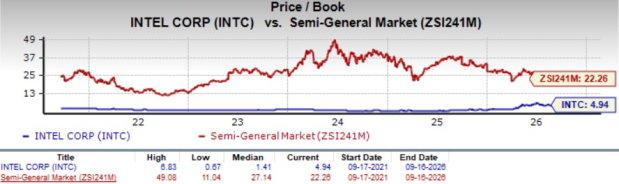
Image Source: Zacks Investment Research
INTC’s earnings estimates for 2026 have increased 44.2% to $1.50 per share, while those for 2027 have increased 30.7% to $1.96 over the past 60 days.
Image Source: Zacks Investment Research
Intel currently carries a Zacks Rank #3 (Hold). You can see the complete list of today’s Zacks #1 Rank (Strong Buy) stocks here.