This is an excerpt from our most recent Economic Outlook report. To access the full PDF, please click here.
(1) Yes. The Federal Open Market Committee (FOMC) can augur in late October.
A +3.0% core PCE rate August is consistent with a durable consumer and business affordability problem, and one that leads to minimal U.S. monthly job additions.
And yes, to this:
On Oct. 6th, CME Fed Funds futures pointed to a 79.3% probability of no Fed Funds hike after the Oct. 28th FOMC meeting.
Why?
Because the FOMC can just wait to raise the Fed Funds policy rate again, after the U.S. midterm election, in early December.
Barring a noted change in U.S. macro data, or a major event happening, Fed Chair Kevin Warsh-driven politics will play a role in determining the outcome of the next FOMC meeting.
Policy rate raises coming from peers like the ECB, the BoJ, the RBA, and the RBNZ matter, too — despite these tightening moves not getting much press inside the USA.
(2) These two quotes from the latest SEPT University of Michigan consumer sentiment survey are worth sharing again:
“The short-run outlook for business conditions plunged amid renewed worries that elevated fuel prices and re-escalating trade disputes could pass through to the economy as a whole.
“Overall, interviews reveal broad agreement across the political spectrum that the outlook for the economy has weakened since the beginning of the year.”
Yes.
That would be the Iran Conflict.
A big dumb U.S. policy mistake. One of the very biggest, in decades.
(3) Do cyclical bulls have a case — coming from the global manufacturing PMI expansion?
“The J.P. Morgan Global Manufacturing PMI® posted a 55-month high of 53.0 in September, up from 52.3 in August, its highest level since February 2022. The headline PMI has signaled expansion for 14 consecutive months.”
A great deal of this “expansion” came from Asian manufacturers (Thailand leading), likely running to stockpile goods and inventories ahead of deeper Strait of Hormuz global supply chain disruptions. This region is among the most affected, by oil supplies from there.
Economist Maia Crook wrote:
“Demand indicators (new orders and export orders) are similarly at multi-year highs, and an ongoing surge in the employment index reinforces our call for a labor market acceleration. This upbeat activity news is coupled with still-sticky input and output price indicators, with the former moving up amidst supply disruptions, higher transport costs, and elevated energy prices.”
(4) Real wage stagnation and a booming stock market?
Not a healthy U.S. political mix!
Over the past 12 months, average U.S. hourly earnings rose +3.0%. This was in line with a core PCE rising +3.0% through AUG 2026, displaying real wage stagnation.
This is what happens when the U.S. Treasury’s General Account looks like this:
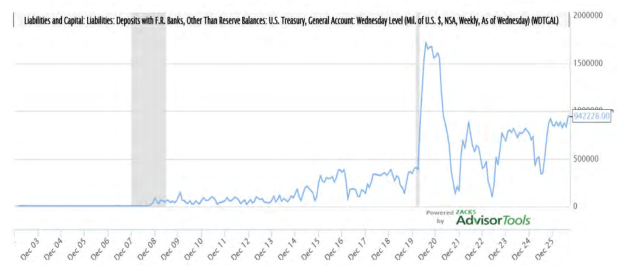
Image Source: Zacks Investment Research
Particularly noticeable is the rising U.S. Treasury issuance since the COVID Pandemic.
Issuance has NOT slowed down, in trend terms, with the passing of the virus from the scene.
There is seasonality — and there is a rise in trend issuance — to note in the chart above.
We are addicted to fueling stellar stock market performances — driven by aggressive U.S. Treasury debt issuance.
Now, U.S. Treasury yields are rising swiftly.
What a surprise! NOT.
This U.S. government debt issuance trend is no longer your stock market friend. But no. I don’t know where the tipping point is. Away from tech mega-caps, it looks to already be here.



 View the Zacks #1 Rank List

Image: Bigstock
Thoughts on the Next FOMC Interest Rate Moves
This is an excerpt from our most recent Economic Outlook report. To access the full PDF, please click here.
(1) Yes. The Federal Open Market Committee (FOMC) can augur in late October.
A +3.0% core PCE rate August is consistent with a durable consumer and business affordability problem, and one that leads to minimal U.S. monthly job additions.
And yes, to this:
On Oct. 6th, CME Fed Funds futures pointed to a 79.3% probability of no Fed Funds hike after the Oct. 28th FOMC meeting.
Why?
Because the FOMC can just wait to raise the Fed Funds policy rate again, after the U.S. midterm election, in early December.
Barring a noted change in U.S. macro data, or a major event happening, Fed Chair Kevin Warsh-driven politics will play a role in determining the outcome of the next FOMC meeting.
Policy rate raises coming from peers like the ECB, the BoJ, the RBA, and the RBNZ matter, too — despite these tightening moves not getting much press inside the USA.
(2) These two quotes from the latest SEPT University of Michigan consumer sentiment survey are worth sharing again:
“The short-run outlook for business conditions plunged amid renewed worries that elevated fuel prices and re-escalating trade disputes could pass through to the economy as a whole.
“Overall, interviews reveal broad agreement across the political spectrum that the outlook for the economy has weakened since the beginning of the year.”
Yes.
That would be the Iran Conflict.
A big dumb U.S. policy mistake. One of the very biggest, in decades.
(3) Do cyclical bulls have a case — coming from the global manufacturing PMI expansion?
“The J.P. Morgan Global Manufacturing PMI® posted a 55-month high of 53.0 in September, up from 52.3 in August, its highest level since February 2022. The headline PMI has signaled expansion for 14 consecutive months.”
A great deal of this “expansion” came from Asian manufacturers (Thailand leading), likely running to stockpile goods and inventories ahead of deeper Strait of Hormuz global supply chain disruptions. This region is among the most affected, by oil supplies from there.
Economist Maia Crook wrote:
“Demand indicators (new orders and export orders) are similarly at multi-year highs, and an ongoing surge in the employment index reinforces our call for a labor market acceleration. This upbeat activity news is coupled with still-sticky input and output price indicators, with the former moving up amidst supply disruptions, higher transport costs, and elevated energy prices.”
(4) Real wage stagnation and a booming stock market?
Not a healthy U.S. political mix!
Over the past 12 months, average U.S. hourly earnings rose +3.0%. This was in line with a core PCE rising +3.0% through AUG 2026, displaying real wage stagnation.
This is what happens when the U.S. Treasury’s General Account looks like this:
Image Source: Zacks Investment Research
Particularly noticeable is the rising U.S. Treasury issuance since the COVID Pandemic.
Issuance has NOT slowed down, in trend terms, with the passing of the virus from the scene.
There is seasonality — and there is a rise in trend issuance — to note in the chart above.
We are addicted to fueling stellar stock market performances — driven by aggressive U.S. Treasury debt issuance.
Now, U.S. Treasury yields are rising swiftly.
What a surprise! NOT.
This U.S. government debt issuance trend is no longer your stock market friend. But no. I don’t know where the tipping point is. Away from tech mega-caps, it looks to already be here.