5 Best AI Stocks to Buy Today
| Company (Ticker) | 12 Week Price Change | Forward PE | Price | Proj EPS Growth (1 Year) | Projected Sales Growth (1Y) |
|---|---|---|---|---|---|
| Micron Technology (MU) | 77.08% | 13.80 | $232.49 | 109.37% | 61.97% |
| NVIDIA (NVDA) | 6.27% | 39.24 | $180.68 | 54.67% | 61.44% |
| Intuitive Surgical (ISRG) | 21.43% | 65.95 | $564.56 | 17.28% | 18.72% |
| Teradyne (TER) | 65.07% | 54.13 | $191.79 | 8.97% | 8.06% |
| Flex (FLEX) | 2.17% | 18.30 | $57.58 | 18.40% | 4.77% |
*Updated on December 3, 2025.
Micron Technology (MU)
$232.49 USD -7.00 (-2.92%)
3-Year Stock Price Performance
Premium Research for MU
- Zacks Rank
- Strong Buy 1
- Style Scores
C Value A Growth B Momentum B VGM
- Market Cap: $270.31 B (Large Cap)
- Projected EPS Growth:109.41%
- Last Quarter EPS Growth:65.32%
- Last EPS Surprise:5.94%
- Next EPS Report date:Dec. 17, 2025
Our Take:
Micron is a leader in DRAM, NAND and high-bandwidth memory (HBM) used to train and run large AI models. Its early HBM3E ramp, designed into flagship accelerator platforms, positions the company squarely in the AI supply chain as memory content and power efficiency rise with each GPU generation.
Demand is rising rapidly, with HBM capacity largely spoken for and AI data centers lifting pricing across DRAM. With AI memory scarcity likely to persist and new nodes expanding bit supply at improving margins, the fundamental picture aligns favorably despite periodic volatility.
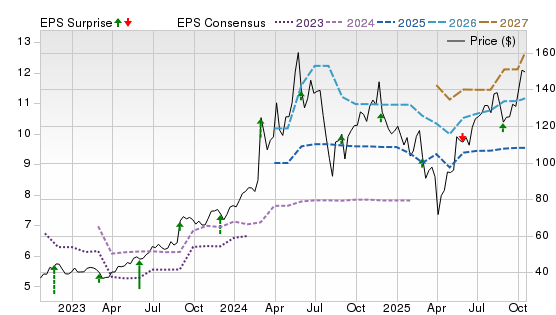
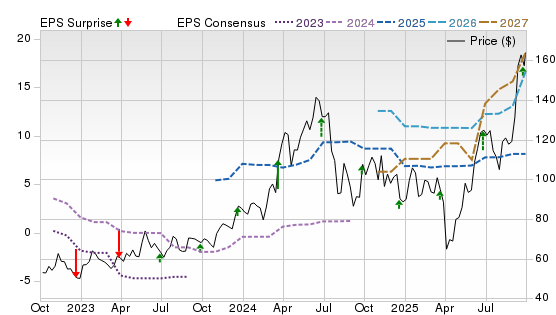
A Zacks Rank #1 (Strong Buy) signals positive estimate revisions, while Style Scores of C for Value and Momentum and A for Growth suggest a growth-led setup with only average valuation and trend support. The Price, Consensus & EPS Surprise chart shows a decisive price uptrend alongside rising 2026–2027 EPS tracks, with mostly positive surprises reinforcing estimate momentum.
NVIDIA (NVDA)
$180.68 USD -0.78 (-0.43%)
3-Year Stock Price Performance
Premium Research for NVDA
- Zacks Rank
Strong Buy 1
- Style Scores
F Value B Growth A Momentum C VGM
- Market Cap: $4,372.06 B (Large Cap)
- Projected EPS Growth: 54.52%
- Last Quarter EPS Growth: 25.25%
- Last EPS Surprise:4.84%
- Next EPS Report date: Feb. 25, 2026
Our Take:
NVIDIA designs the hardware, networking and software stack that powers modern AI, led by its Blackwell architecture and full-stack platforms that dominate data-center acceleration. The latest quarter showcased record revenue and a step-function increase in data-center sales.
Blackwell’s wide adoption by clouds and enterprises extends NVIDIA’s ecosystem moat and supports visibility into next-gen upgrades, along with an improved mix. While investing heavily in future growth, shareholder returns remain a priority, with $12.7 billion deployed in the last quarter alone. With secular AI demand and a robust product pipeline, estimate momentum and technicals remain constructive.
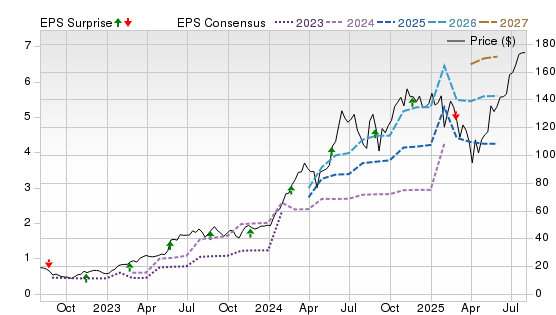
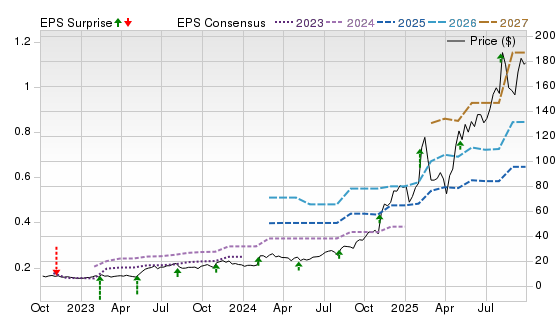
A Zacks Rank #1 reflects continued upward estimate revisions. Style Scores of F for Value, B for Growth and A for Momentum point to a premium valuation offset by strong earnings trajectories and powerful trend support. On the chart, price tracks a rising path with 2025–2027 consensus lines stair-stepping higher, validating fundamentals despite intermittent volatility.
Intuitive Surgical (ISRG)
$564.56 USD -3.16 (-0.56%)
3-Year Stock Price Performance
Premium Research for ISRG
- Zacks Rank
Strong Buy 1
- Style Scores
F Value D Growth D Momentum F VGM
- Market Cap:$203.39 B (Large Cap)
- Projected EPS Growth:17.30%
- Last Quarter EPS Growth: 7.10%
- Last EPS Surprise: 20.60%
- Next EPS Report date: Jan. 22, 2026
Our Take:
Intuitive Surgical is a leader in robotic-assisted surgery. Its newest system, da Vinci 5, adds far greater computing and advanced data analytics features that lay the groundwork for AI-enhanced guidance and workflow. Procedure growth and system placements remain key drivers, while a strong balance sheet provides flexibility.
Recent quarters showed healthy revenue growth and procedure expansion as hospitals adopt newer platforms, while software capabilities deepen the potential for recurring revenue. While tariff and capital-budget risks can inject volatility, the combination of scale leadership and expanding digital and AI features underpins a balanced, longer-term case.
A Zacks Rank #1 indicates improving estimates, but Style Scores of F for Value, D for Growth and C for Momentum suggest investors already discount much of the story and expect steady execution. The price chart shows shares rebounding as 2026–2027 EPS tracks inflect upward after a flat period, with positive surprises supporting the turn.
Teradyne (TER)
$191.79 USD +1.85 (0.97%)
3-Year Stock Price Performance
Premium Research for TER
- Zacks Rank
Buy 2
- Style Scores
D Value F Growth F Momentum F VGM
- Market Cap:$28.13 B (Large Cap)
- Projected EPS Growth: 9.01%
- Last Quarter EPS Growth:49.12%
- Last EPS Surprise: 8.97%
- Next EPS Report date:Feb 4, 2026
Our Take:
Teradyne leads in automated test gear for advanced compute, memory and AI chips, with robotics adding extra upside. Although results can be uneven each quarter, its role in the AI stack’s verification layer keeps it tied to new nodes and rising HBM demand.
Management noted solid AI-driven strength in compute and memory, product and ecosystem updates, including UR’s NVIDIA work, broadening Teradyne’s reach. This expanded platform supports future growth and improves its long-term competitive positioning in AI.
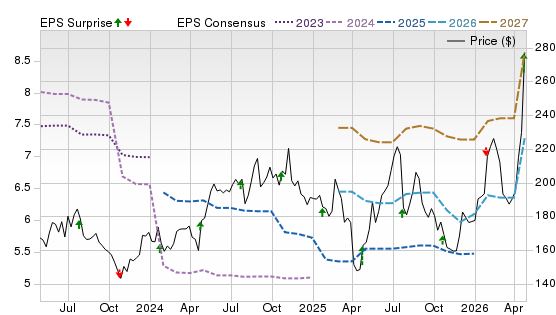
A Zacks Rank #2 (Buy) reflects positive revisions, while Style Scores of D for Value, F for Growth and Momentum flag weaker near-term factors and a need for continued order follow-through. On the chart, estimates for 2026–2027 trend higher as price consolidates after a strong multi-year run, typical for order-cycle names. If AI test intensity and packaging complexity persist, the estimate momentum should remain a supportive catalyst.
Flex (FLEX)
$57.58 USD +0.16 (0.28%)
3-Year Stock Price Performance
Premium Research for FLEX
- Zacks Rank
Buy 2
- Style Scores
A Value B Growth C Momentum A VGM
- Market Cap:$20.91 B (Large Cap)
- Projected EPS Growth:18.49%
- Last Quarter EPS Growth:9.38%
- Last EPS Surprise:5.33%
- Next EPS Report date:Feb. 4, 2026
Our Take:
Flex is a diversified manufacturing and supply-chain partner with a growing AI data-center franchise spanning racks, power and advanced liquid-cooling, critical as hyperscalers deploy denser AI systems. Its new AI Infrastructure Platform combines power, cooling and compute into one system, helping deploy high-density AI data centers nearly 30% faster.
Flex’s end-to-end lifecycle capabilities and vertical integration help deepen relationships with cloud customers. Improving trends in Automotive and Renewables, along with growth in Medical Devices, Optical and Satcom, are expected to support its long-term growth.
A Zacks Rank #2 with Style Scores of A for Value, B for Growth and Momentum presents an exciting setup with attractive valuation, improving earnings drivers and solid trend support tied to AI build-outs. The chart shows a choppy but rising price series with 2026–2027 EPS tracks inflecting upward, consistent with a mix shift toward higher-margin data-center solutions.
Methodology
The Zacks Rank is a proprietary stock-rating model that uses trends in earnings estimate revisions and earnings-per-share (EPS) surprises to classify stocks into five groups: #1 (Strong Buy), #2 (Buy), #3 (Hold), #4 (Sell) and #5 (Strong Sell). The Zacks Rank is calculated through four primary factors related to earnings estimates: analysts' consensus on earnings estimate revisions, the magnitude of revision change, the upside potential and estimate surprise (or the degree in which earnings per share deviated from the previous quarter).
Zacks builds the data from 3,000 analysts at over 150 different brokerage firms. The average yearly gain for Zacks Rank #1 (Strong Buy) stocks is +23.62% per year from January, 1988, through June 2, 2025.
Selections for Best AI Stocks are based on the current top ranking stocks based on Zacks Indicator Score. For this list, only companies that have average daily trading volumes of 100,000 shares or more and at least five analysts covering the stock were considered. All information is current as of market open, Dec. 2, 2025.
Guide to AI Stocks
The classification of “AI Stocks” is actually quite broad, ranging from companies that provide the essential hardware, companies that create the software to run Large Language Models, and a whole host of other industries and companies that are creating the Artificial Intelligence ecosystem. All stand to gain – or lose – depending on the fortunes of AI tech.
Types of AI Stocks
Hardware (GPUs, Chips) Stocks – NVIDIA, AMD, TSMC, Broadcom
The backbone of AI is raw computing power, and this comes primarily from specialized chips like graphics processing units (GPUs) and AI-focused accelerators. NVIDIA (NVDA) is the undisputed leader in GPUs used for training large language models.
Advanced Micro Devices (AMD) is a rising competitor, with its MI300 series targeting data center AI workloads. Taiwan Semiconductor Manufacturing Co. (TSMC) doesn’t make its own chips but manufactures advanced nodes for nearly every big tech firm—including Apple, Nvidia, and AMD—making it critical to the global AI supply chain. Broadcom (AVGO) has carved a niche in custom ASICs (application-specific integrated circuits) for hyperscale cloud providers, which value tailored chips that reduce energy use and maximize throughput.
These companies benefit from structural demand for more computing capacity, but they also face geopolitical risks such as U.S.-China export restrictions and cyclical swings in semiconductor demand.
AI Cloud & Infrastructure – Microsoft, Amazon, Alphabet
Building AI applications at scale requires massive computing infrastructure. Azure from Microsoft (MSFT) has become a leader by integrating OpenAI’s models directly into its cloud offerings, giving it a first-mover advantage in AI enterprise adoption. Amazon Web Services, a subsidiary of Amazon (AMZN) is deploying its in-house Trainium and Inferentia chips, aiming to lower costs for AI workloads while retaining dominance in cloud services. Alphabet’s (GOOG) Google Cloud is leaning heavily on its proprietary Tensor Processing Units (TPUs) and Gemini AI models to differentiate itself.
Investing in these players is less about speculative growth and more about diversified tech giants whose AI investments bolster an already profitable core business.
Enterprise AI Software & Analytics – Palantir, C3.ai, Adobe, Snowflake
AI isn’t just about hardware; software platforms are where businesses actually apply machine intelligence. Palantir (PLTR) powers decision-making for defense and large corporations with its Foundry and Gotham platforms. C3.ai (AI) focuses specifically on AI-driven applications across industries like energy, finance, and manufacturing. Adobe (ADBE) has integrated AI across its creative suite (e.g., Firefly in Photoshop), while Snowflake (SNOW) has added AI-enabled analytics to its cloud data warehousing business.
These stocks tend to have higher growth potential but also higher risk, as adoption timelines and customer budgets can vary widely.
Cybersecurity AI – CrowdStrike
The rise of AI also heightens cyber risks. CrowdStrike (CRWD) leads in AI-powered threat detection, using machine learning to flag suspicious behavior across millions of endpoints in real time. With ransomware and nation-state attacks increasing, demand for AI-driven security remains strong. Cybersecurity names often benefit from recurring revenue models, which may help smooth out volatility compared to hardware peers.
Benefits and Risks of AI Stocks
Benefits:
- Secular Growth: AI adoption is still in early innings, with enterprise use cases expanding rapidly.
- Diversified Exposure: Investors can target infrastructure, software, or services depending on risk tolerance.
- First-Mover Advantage: Leaders like NVIDIA and Microsoft are shaping the ecosystem, creating strong economic moats.
Risks:
- Valuations: Many AI leaders are priced for perfection, leaving little margin of safety.
- Hype Cycle: Investor enthusiasm may outrun near-term fundamentals, creating bubble risk.
- Regulation: Governments are exploring AI rules around privacy, bias, and national security, which could reshape business models.
- Competition: Barriers to entry are high, but fast innovation means today’s leader can quickly lose ground.
How to Choose AI Stocks
When evaluating AI stocks, consider:
- Revenue Mix: How much of the company’s growth is truly driven by AI vs. traditional segments?
- Moat & Differentiation: Does the company control unique technology (like NVIDIA’s CUDA software ecosystem)?
- Customer Adoption: Look for companies with recurring contracts or wide adoption across industries.
- Financial Health: Strong balance sheets matter in a capital-intensive industry.
- Valuation Metrics: Compare price-to-earnings (P/E) ratio, price-to-sales (P/S) ratio, and forward growth projections to industry peers.
How to Invest in AI Stocks
There are multiple entry points depending on your goals:
- Direct Stock Picks: Best if you want concentrated exposure to specific company leaders or disruptors.
- AI Exchange-Traded Funds (ETFs): ETFs such as Global X Robotics & Artificial Intelligence ETF (BOTZ) or iShares Robotics and AI ETF (IRBO) provide diversification by investing in a broad range of companies in the AI space.
- Broad Tech ETFs: Like Invesco QQQ (QQQ) or Vanguard Information Technology ETF (VGT), offering AI exposure as part of a bigger tech basket.
- Dollar-Cost Averaging (DCA): A strategy to smooth price volatility by buying at regular intervals AI stocks or funds.
- Long-Term Holds: Since AI is a multi-decade trend, investors who can weather short-term swings may see the best results.
AI Stocks Alternatives
If you want exposure to AI without betting on a single stock:
- ETFs: Offer diversification and reduce single-company risk.
- Private Markets: Startups in robotics, generative AI, and enterprise AI could offer upside, though access is limited to accredited investors, which face income or licensing limitations (such as a net worth of $1 million, excluding primary residence, plus a high annual income – $300,000 if married.
- Picks-and-Shovels Plays: Companies supplying infrastructure, like power management (e.g., Eaton) or data center REITs (e.g., Equinix), benefit indirectly from AI growth.
Strategies for AI Stocks Moving Forward
- Barbell Approach: Combine stable mega-caps (Microsoft, Nvidia) with speculative names (Quantum Computing Inc., Credo) for balanced exposure.
- Rebalancing: Trim positions after strong rallies to lock in gains and redeploy into underweighted sectors.
- Monitor Earnings: Focus on whether AI adoption translates into sustainable revenue growth.
- Look Beyond the U.S.: Consider emerging AI leaders in Europe and Asia for diversification.
- Stay Agile: AI is evolving rapidly; reassess holdings every quarter as new winners emerge.
Frequently Asked Questions About AI Stocks
Are AI stocks overvalued?
Many AI leaders are priced at steep multiples compared to the broader market. That doesn’t mean all are bubbles, but investors should separate hype from earnings-driven growth.
What is the forecast for AI stocks?
Most analysts expect AI demand to expand through at least the next decade, with data center spending, AI-as-a-service, and AI-enabled enterprise tools driving revenue.
What metrics best signal AI efficacy?
- Growth in AI-specific revenue lines.
- Gross margin improvements tied to AI.
- Customer retention and expansion.
- Evidence of scale: Contracts, partnerships, recurring revenue.