We use cookies to understand how you use our site and to improve your experience.
This includes personalizing content and advertising.
By pressing "Accept All" or closing out of this banner, you consent to the use of all cookies and similar technologies and the sharing of information they collect with third parties.
You can reject marketing cookies by pressing "Deny Optional," but we still use essential, performance, and functional cookies.
In addition, whether you "Accept All," Deny Optional," click the X or otherwise continue to use the site, you accept our Privacy Policy and Terms of Service, revised from time to time.
You are being directed to ZacksTrade, a division of LBMZ Securities and licensed broker-dealer. ZacksTrade and Zacks.com are separate companies. The web link between the two companies is not a solicitation or offer to invest in a particular security or type of security. ZacksTrade does not endorse or adopt any particular investment strategy, any analyst opinion/rating/report or any approach to evaluating individual securities.
If you wish to go to ZacksTrade, click OK. If you do not, click Cancel.
BHP vs. SCCO: Which Copper Stock is the Better Buy?
Read MoreHide Full Article
Key Takeaways
BHP is shifting portfolio toward copper and potash, now ~70% of capital allocation.
SCCO expects 2026 copper production around 911,400 tons, a 4.7% decline from 2025.
SCCO targets ~1.6M tons copper by 2035, backed by major Peru and Mexico projects.
BHP Group Limited (BHP - Free Report) and Southern Copper Corporation (SCCO - Free Report) both offer meaningful exposure to copper, a key metal underpinning electrification, renewable energy expansion and long-term infrastructure growth.
BHP, with a market capitalization of $177 billion, is a diversified mining giant producing iron ore, copper, uranium, gold, zinc, lead, molybdenum, silver, cobalt, and both metallurgical and energy coal. In comparison, Southern Copper, valued at roughly $134 billion, is more copper-focused, with additional output of molybdenum, zinc, silver, gold and lead.
The long-term outlook for copper remains constructive, supported by rising demand from electric vehicles, renewable energy systems and infrastructure development. Against this backdrop, investors are evaluating which stock is better positioned, BHP or SCCO? To make an informed decision, let us analyze their fundamentals, growth potential and key challenges.
The Case for BHP Group
BHP is actively reshaping its portfolio toward future-facing commodities, particularly copper and potash, which together account for nearly 70% of its medium-term capital allocation. BHP has achieved 30% growth in copper production in the last four years.
Copper production reached 984 kt in the first half of fiscal 2026. Escondida achieved record concentrator throughput and improved recoveries, aided by operational enhancements. Copper SA delivered a record amount of material mined. Copper output is targeted at 1,900-2,000 kt in fiscal 2026.
The company recently submitted the "Escondida New Concentrator" project to the Environmental Assessment System as part of its ongoing efforts to grow the business. The new concentrator, with a likely investment of $4.4-$5.9 billion, will replace the historic Los Colorados plant, which is approaching the end of its operating life. BHP plans to install new capacity to produce 220 – 260 kt of copper annually.
Resolution Copper, a joint venture owned by BHP (45%) and Rio Tinto (55%), and the United States Forest Service (USFS) have announced the completion of a Federal land exchange. This milestone enables the next phase of technical work and development planning for the Resolution Copper project, which is one of the most significant undeveloped copper resources in the United States.
BHP has copper projects under execution and a pipeline that could deliver around 2 Mtpa of attributable copper production by the 2030s.
BHP is also advancing the Jansen Stage 1 potash project, a large-scale, low-cost, high-grade resource with a mine life exceeding 100 years. BHP is working toward its first production by mid-2027. Meanwhile, the company is also investing in growing its iron ore business. Over the medium term, WAIO production is expected to exceed 305 Mt annually, supported by expanded rail operation capacity unlocked by RTP1 and the Western Ridge Crusher Project. BHP is investing in a sixth car dumper and related infrastructure at Port Hedland.
The Case for SCCO
Southern Copper has the largest copper reserves in the industry and operates high-quality, world-class assets in investment-grade countries, such as Mexico and Peru.
Copper production was 956,270 tons in 2025, reflecting a modest 1.8% year-over-year decline and falling 1% short of its guidance. Lower output at Buenavista and the Peruvian mines, partially offset by a rise in production at IMMSA and La Caridad mines, led to decreased numbers for the year.
Expecting weaker ore grades at its Peruvian mines, SCCO projects 2026 copper production at around 911,400 tons, suggesting a 4.7% decline from 2025 levels. Despite these near-term headwinds, Southern Copper maintains a strong long-term outlook, targeting a significant ramp-up in output to roughly 1.6 million tons by 2035. This implies a compound annual growth rate (CAGR) of approximately 5.3% from 2025 levels.
To support this growth plan, the company intends to invest nearly $19.9 billion over the next decade, with the bulk of the capital allocated to projects in Peru. A substantial portion of this spending is scheduled through 2031 as key development projects progress.
Production is expected to increase to about 1.15 million tons by 2031, surge to roughly 1.476 million tons in 2032 and continue rising steadily to reach the above-mentioned 1.6 million ton target by 2035. This trajectory highlights SCCO’s confidence in its robust and diversified project pipeline spanning Peru and Mexico.
Key growth catalysts include the Tía María, Los Chancas and Michiquillay projects in Peru, along with El Pilar and El Arco in Mexico, all of which underpin SCCO’s long-term expansion pipeline.
How Does the Zacks Consensus Estimate Compare for BHP & SCCO?
The Zacks Consensus Estimate for BHP’s fiscal 2026 earnings per share of $4.94 indicates growth of 35.7%. The same for fiscal 2027 suggests a 0.3% dip.
The Zacks Consensus Estimate for SCCO’s fiscal 2026 EPS of $6.57 implies year-over-year growth of 25.4%. The company’s EPS estimates for fiscal 2027 imply a decline of 4.95%.
Image Source: Zacks Investment Research
The estimates for BHP for both fiscal 2026 and 2027 has moved up in the past 60 days. The estimate for SCCO for both 2026 and 2027 has also moved up in the past 60 days.
Image Source: Zacks Investment Research
Price Performance and Valuation of RIO & BHP
In the past year, BHP shares have risen 43.2%, while SCCO stock has surged 73.4%.
Image Source: Zacks Investment Research
BHP is trading at a forward 12-month price-to-earnings ratio of 14.11X, while Southern Copper’s forward earnings multiple sits at 24.97X. BHP has a Value Score of B, while SCCO has a Value Score of D.
Image Source: Zacks Investment Research
Final Take
Both stocks currently carry a Zacks Rank #3 (Hold), so choosing one is difficult. Both are poised to benefit from strong momentum in the copper market, supported by strong asset bases and expanding production pipelines. However, SCCO faces near-term production headwinds and offers a more expensive valuation. BHP’s diversified earnings base and more attractive valuation give it an edge.



 View the Zacks #1 Rank List
Image: Bigstock
BHP vs. SCCO: Which Copper Stock is the Better Buy?
Key Takeaways
BHP Group Limited (BHP - Free Report) and Southern Copper Corporation (SCCO - Free Report) both offer meaningful exposure to copper, a key metal underpinning electrification, renewable energy expansion and long-term infrastructure growth.
BHP, with a market capitalization of $177 billion, is a diversified mining giant producing iron ore, copper, uranium, gold, zinc, lead, molybdenum, silver, cobalt, and both metallurgical and energy coal. In comparison, Southern Copper, valued at roughly $134 billion, is more copper-focused, with additional output of molybdenum, zinc, silver, gold and lead.
The long-term outlook for copper remains constructive, supported by rising demand from electric vehicles, renewable energy systems and infrastructure development. Against this backdrop, investors are evaluating which stock is better positioned, BHP or SCCO? To make an informed decision, let us analyze their fundamentals, growth potential and key challenges.
The Case for BHP Group
BHP is actively reshaping its portfolio toward future-facing commodities, particularly copper and potash, which together account for nearly 70% of its medium-term capital allocation. BHP has achieved 30% growth in copper production in the last four years.
Copper production reached 984 kt in the first half of fiscal 2026. Escondida achieved record concentrator throughput and improved recoveries, aided by operational enhancements. Copper SA delivered a record amount of material mined. Copper output is targeted at 1,900-2,000 kt in fiscal 2026.
The company recently submitted the "Escondida New Concentrator" project to the Environmental Assessment System as part of its ongoing efforts to grow the business. The new concentrator, with a likely investment of $4.4-$5.9 billion, will replace the historic Los Colorados plant, which is approaching the end of its operating life. BHP plans to install new capacity to produce 220 – 260 kt of copper annually.
Resolution Copper, a joint venture owned by BHP (45%) and Rio Tinto (55%), and the United States Forest Service (USFS) have announced the completion of a Federal land exchange. This milestone enables the next phase of technical work and development planning for the Resolution Copper project, which is one of the most significant undeveloped copper resources in the United States.
BHP has copper projects under execution and a pipeline that could deliver around 2 Mtpa of attributable copper production by the 2030s.
BHP is also advancing the Jansen Stage 1 potash project, a large-scale, low-cost, high-grade resource with a mine life exceeding 100 years. BHP is working toward its first production by mid-2027. Meanwhile, the company is also investing in growing its iron ore business. Over the medium term, WAIO production is expected to exceed 305 Mt annually, supported by expanded rail operation capacity unlocked by RTP1 and the Western Ridge Crusher Project. BHP is investing in a sixth car dumper and related infrastructure at Port Hedland.
The Case for SCCO
Southern Copper has the largest copper reserves in the industry and operates high-quality, world-class assets in investment-grade countries, such as Mexico and Peru.
Copper production was 956,270 tons in 2025, reflecting a modest 1.8% year-over-year decline and falling 1% short of its guidance. Lower output at Buenavista and the Peruvian mines, partially offset by a rise in production at IMMSA and La Caridad mines, led to decreased numbers for the year.
Expecting weaker ore grades at its Peruvian mines, SCCO projects 2026 copper production at around 911,400 tons, suggesting a 4.7% decline from 2025 levels.
Despite these near-term headwinds, Southern Copper maintains a strong long-term outlook, targeting a significant ramp-up in output to roughly 1.6 million tons by 2035. This implies a compound annual growth rate (CAGR) of approximately 5.3% from 2025 levels.
To support this growth plan, the company intends to invest nearly $19.9 billion over the next decade, with the bulk of the capital allocated to projects in Peru. A substantial portion of this spending is scheduled through 2031 as key development projects progress.
Production is expected to increase to about 1.15 million tons by 2031, surge to roughly 1.476 million tons in 2032 and continue rising steadily to reach the above-mentioned 1.6 million ton target by 2035. This trajectory highlights SCCO’s confidence in its robust and diversified project pipeline spanning Peru and Mexico.
Key growth catalysts include the Tía María, Los Chancas and Michiquillay projects in Peru, along with El Pilar and El Arco in Mexico, all of which underpin SCCO’s long-term expansion pipeline.
How Does the Zacks Consensus Estimate Compare for BHP & SCCO?
The Zacks Consensus Estimate for BHP’s fiscal 2026 earnings per share of $4.94 indicates growth of 35.7%. The same for fiscal 2027 suggests a 0.3% dip.
The Zacks Consensus Estimate for SCCO’s fiscal 2026 EPS of $6.57 implies year-over-year growth of 25.4%. The company’s EPS estimates for fiscal 2027 imply a decline of 4.95%.
Image Source: Zacks Investment Research
The estimates for BHP for both fiscal 2026 and 2027 has moved up in the past 60 days. The estimate for SCCO for both 2026 and 2027 has also moved up in the past 60 days.
Image Source: Zacks Investment Research
Price Performance and Valuation of RIO & BHP
In the past year, BHP shares have risen 43.2%, while SCCO stock has surged 73.4%.
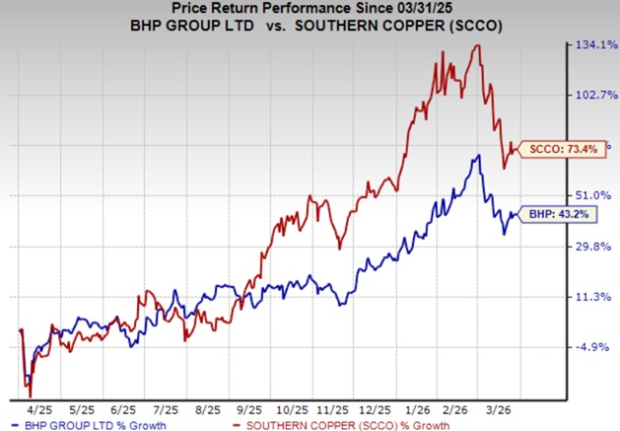
Image Source: Zacks Investment Research
BHP is trading at a forward 12-month price-to-earnings ratio of 14.11X, while Southern Copper’s forward earnings multiple sits at 24.97X. BHP has a Value Score of B, while SCCO has a Value Score of D.
Image Source: Zacks Investment Research
Final Take
Both stocks currently carry a Zacks Rank #3 (Hold), so choosing one is difficult. Both are poised to benefit from strong momentum in the copper market, supported by strong asset bases and expanding production pipelines. However, SCCO faces near-term production headwinds and offers a more expensive valuation. BHP’s diversified earnings base and more attractive valuation give it an edge.
You can see the complete list of today’s Zacks #1 Rank (Strong Buy) stocks here.