We use cookies to understand how you use our site and to improve your experience.
This includes personalizing content and advertising.
By pressing "Accept All" or closing out of this banner, you consent to the use of all cookies and similar technologies and the sharing of information they collect with third parties.
You can reject marketing cookies by pressing "Deny Optional," but we still use essential, performance, and functional cookies.
In addition, whether you "Accept All," Deny Optional," click the X or otherwise continue to use the site, you accept our Privacy Policy and Terms of Service, revised from time to time.
You are being directed to ZacksTrade, a division of LBMZ Securities and licensed broker-dealer. ZacksTrade and Zacks.com are separate companies. The web link between the two companies is not a solicitation or offer to invest in a particular security or type of security. ZacksTrade does not endorse or adopt any particular investment strategy, any analyst opinion/rating/report or any approach to evaluating individual securities.
If you wish to go to ZacksTrade, click OK. If you do not, click Cancel.
Dividend stocks are strong choice for investors looking for both growth and consistent income.
Long-term investors need to beware of stocks with high-dividend yields, yet poor financial fundamentals.
Some high-ranking dividend stocks for reliable income include Prudential Financial, Wiley and Kite Realty.
Dividend stocks share a slice of profits with investors, delivering steady cash that can help meet liquidity needs and temper portfolio swings when markets are choppy. Over time, reinvested payouts have been a major driver of total return—quietly compounding even when prices stall.
Picking the right payers is the hard part. A high yield alone can be a warning sign; “dividend traps” often pair eye-catching payouts with weak balance sheets or eroding cash flows that invite cuts. The better approach is to focus on durability: moderate payout ratios, consistent free cash generation, prudent leverage, and a record of maintaining or raising dividends.
With that framework, we highlight dividend stocks that combine sustainable income with reasonable entry point. The goal is simple: reliable, repeatable income from businesses built to keep paying through the cycle.
This is our short term rating system that serves as a timeliness indicator for stocks over the next 1 to 3 months. How good is it? See rankings and related performance below.
The Zacks Industry Rank assigns a rating to each of the 265 X (Expanded) Industries based on their average Zacks Rank.
An industry with a larger percentage of Zacks Rank #1's and #2's will have a better average Zacks Rank than one with a larger percentage of Zacks Rank #4's and #5's.
The industry with the best average Zacks Rank would be considered the top industry (1 out of 265), which would place it in the top 1% of Zacks Ranked Industries. The industry with the worst average Zacks Rank (265 out of 265) would place in the bottom 1%.
The Zacks Sector Rank assigns a rating to each of the 16 Sectors based on their average Zacks Rank.
A sector with a larger percentage of Zacks Rank #1's and #2's will have a better average Zacks Rank than one with a larger percentage of Zacks Rank #4's and #5's.
The sector with the best average Zacks Rank would be considered the top sector (1 out of 16), which would place it in the top 1% of Zacks Ranked Sectors. The sector with the worst average Zacks Rank (16 out of 16) would place in the bottom 1%.
The Style Scores are a complementary set of indicators to use alongside the Zacks Rank. It allows the user to better focus on the stocks that are the best fit for his or her personal trading style.
The scores are based on the trading styles of Value, Growth, and Momentum. There's also a VGM Score ('V' for Value, 'G' for Growth and 'M' for Momentum), which combines the weighted average of the individual style scores into one score.
Value ScoreA
Growth ScoreA
Momentum ScoreA
VGM ScoreA
Within each Score, stocks are graded into five groups: A, B, C, D and F. As you might remember from your school days, an A, is better than a B; a B is better than a C; a C is better than a D; and a D is better than an F.
As an investor, you want to buy stocks with the highest probability of success. That means you want to buy stocks with a Zacks Rank #1 or #2, Strong Buy or Buy, which also has a Score of an A or a B in your personal trading style.
Zacks Earnings ESP (Expected Surprise Prediction) looks to find companies that have recently seen positive earnings estimate revision activity. The idea is that more recent information is, generally speaking, more accurate and can be a better predictor of the future, which can give investors an advantage in earnings season.
The technique has proven to be very useful for finding positive surprises. In fact, when combining a Zacks Rank #3 or better and a positive Earnings ESP, stocks produced a positive surprise 70% of the time, while they also saw 28.3% annual returns on average, according to our 10 year backtest.
Prudential is a global insurer and retirement/asset-management provider spanning U.S. workplace benefits, annuities and PGIM. In Q4 2025, AOI rose 11.5% year over year, helped by stronger net investment spread and underwriting in U.S. Businesses while PGIM’s AUM grew 7%. With a 5.67% yield and a moderate payout ratio, the dividend looks well-covered by earnings power. Management pairs dividends with buybacks.
Potential Risks
Insurers remain sensitive to equity and credit markets and claims volatility. PRU also flagged remediation steps tied to Japan sales practices.
Forecast
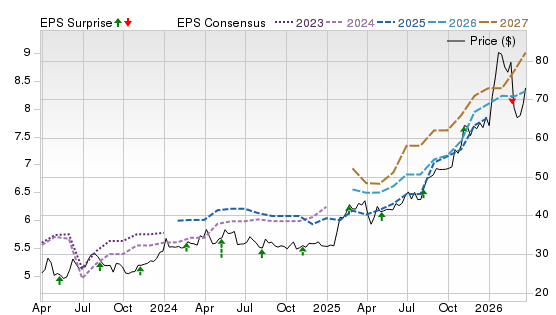
A Zacks Rank #3 (Hold) with Style Scores of A for Value, C for Growth and F for Momentum tilts the setup toward valuation support rather than near-term price strength. The Price, Consensus & EPS Surprise chart shows the stock trending lower alongside choppy surprises and a 2025–2026 consensus that steps down, implying investors want clearer estimate stabilization before re-rating.
This is our short term rating system that serves as a timeliness indicator for stocks over the next 1 to 3 months. How good is it? See rankings and related performance below.
The Zacks Industry Rank assigns a rating to each of the 265 X (Expanded) Industries based on their average Zacks Rank.
An industry with a larger percentage of Zacks Rank #1's and #2's will have a better average Zacks Rank than one with a larger percentage of Zacks Rank #4's and #5's.
The industry with the best average Zacks Rank would be considered the top industry (1 out of 265), which would place it in the top 1% of Zacks Ranked Industries. The industry with the worst average Zacks Rank (265 out of 265) would place in the bottom 1%.
The Zacks Sector Rank assigns a rating to each of the 16 Sectors based on their average Zacks Rank.
A sector with a larger percentage of Zacks Rank #1's and #2's will have a better average Zacks Rank than one with a larger percentage of Zacks Rank #4's and #5's.
The sector with the best average Zacks Rank would be considered the top sector (1 out of 16), which would place it in the top 1% of Zacks Ranked Sectors. The sector with the worst average Zacks Rank (16 out of 16) would place in the bottom 1%.
The Style Scores are a complementary set of indicators to use alongside the Zacks Rank. It allows the user to better focus on the stocks that are the best fit for his or her personal trading style.
The scores are based on the trading styles of Value, Growth, and Momentum. There's also a VGM Score ('V' for Value, 'G' for Growth and 'M' for Momentum), which combines the weighted average of the individual style scores into one score.
Value ScoreA
Growth ScoreA
Momentum ScoreA
VGM ScoreA
Within each Score, stocks are graded into five groups: A, B, C, D and F. As you might remember from your school days, an A, is better than a B; a B is better than a C; a C is better than a D; and a D is better than an F.
As an investor, you want to buy stocks with the highest probability of success. That means you want to buy stocks with a Zacks Rank #1 or #2, Strong Buy or Buy, which also has a Score of an A or a B in your personal trading style.
Zacks Earnings ESP (Expected Surprise Prediction) looks to find companies that have recently seen positive earnings estimate revision activity. The idea is that more recent information is, generally speaking, more accurate and can be a better predictor of the future, which can give investors an advantage in earnings season.
The technique has proven to be very useful for finding positive surprises. In fact, when combining a Zacks Rank #3 or better and a positive Earnings ESP, stocks produced a positive surprise 70% of the time, while they also saw 28.3% annual returns on average, according to our 10 year backtest.
Wiley sells research publishing and education content, with a business mix that skews to recurring, digital revenue. In fiscal Q3 2026, it generated solid adjusted earnings as it continued to emphasize higher-value workflows and licensing opportunities tied to research content. The 4.66% yield is supported by a manageable payout ratio and a business model that allows for cash conversion to improve as restructuring and portfolio simplification take hold.
Potential Risks
Publishing demand can be lumpy, and Wiley is exposed to institutional budgets, subscription renewal dynamics, and execution risks associated with divestitures and cost programs.
Forecast
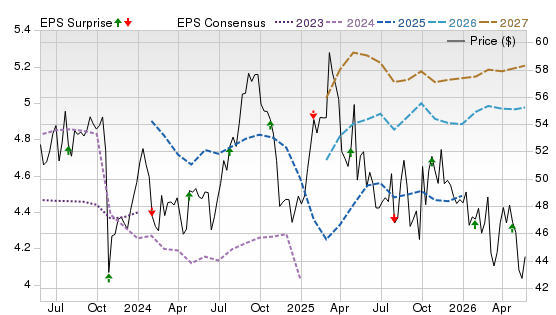
WLY currently carries a Zacks Rank #3, while B for Value, F for Growth and D for Momentum suggest valuation doing most of the work as growth expectations lag. In the chart, the price has trended higher with a rising forward consensus line, suggesting estimates have been drifting up.
This is our short term rating system that serves as a timeliness indicator for stocks over the next 1 to 3 months. How good is it? See rankings and related performance below.
The Zacks Industry Rank assigns a rating to each of the 265 X (Expanded) Industries based on their average Zacks Rank.
An industry with a larger percentage of Zacks Rank #1's and #2's will have a better average Zacks Rank than one with a larger percentage of Zacks Rank #4's and #5's.
The industry with the best average Zacks Rank would be considered the top industry (1 out of 265), which would place it in the top 1% of Zacks Ranked Industries. The industry with the worst average Zacks Rank (265 out of 265) would place in the bottom 1%.
The Zacks Sector Rank assigns a rating to each of the 16 Sectors based on their average Zacks Rank.
A sector with a larger percentage of Zacks Rank #1's and #2's will have a better average Zacks Rank than one with a larger percentage of Zacks Rank #4's and #5's.
The sector with the best average Zacks Rank would be considered the top sector (1 out of 16), which would place it in the top 1% of Zacks Ranked Sectors. The sector with the worst average Zacks Rank (16 out of 16) would place in the bottom 1%.
The Style Scores are a complementary set of indicators to use alongside the Zacks Rank. It allows the user to better focus on the stocks that are the best fit for his or her personal trading style.
The scores are based on the trading styles of Value, Growth, and Momentum. There's also a VGM Score ('V' for Value, 'G' for Growth and 'M' for Momentum), which combines the weighted average of the individual style scores into one score.
Value ScoreA
Growth ScoreA
Momentum ScoreA
VGM ScoreA
Within each Score, stocks are graded into five groups: A, B, C, D and F. As you might remember from your school days, an A, is better than a B; a B is better than a C; a C is better than a D; and a D is better than an F.
As an investor, you want to buy stocks with the highest probability of success. That means you want to buy stocks with a Zacks Rank #1 or #2, Strong Buy or Buy, which also has a Score of an A or a B in your personal trading style.
Zacks Earnings ESP (Expected Surprise Prediction) looks to find companies that have recently seen positive earnings estimate revision activity. The idea is that more recent information is, generally speaking, more accurate and can be a better predictor of the future, which can give investors an advantage in earnings season.
The technique has proven to be very useful for finding positive surprises. In fact, when combining a Zacks Rank #3 or better and a positive Earnings ESP, stocks produced a positive surprise 70% of the time, while they also saw 28.3% annual returns on average, according to our 10 year backtest.
Kite Realty owns open-air, grocery-anchored shopping centers and mixed-use assets. In 2025, it leased roughly 4.6 million square feet at double-digit comparable cash leasing spreads, repositioned the portfolio through asset sales, and added capital flexibility via joint ventures. Its 4.48% yield is backed by a REIT-typical payout ratio. Its five-year dividend growth of above 12% is consistent with management's focus on shareholder returns.
Potential Risks
REITs are rate-sensitive: higher-for-longer funding costs can compress values and slow acquisition economics. Retail real estate also faces tenant credit risk if consumer demand softens.
Forecast
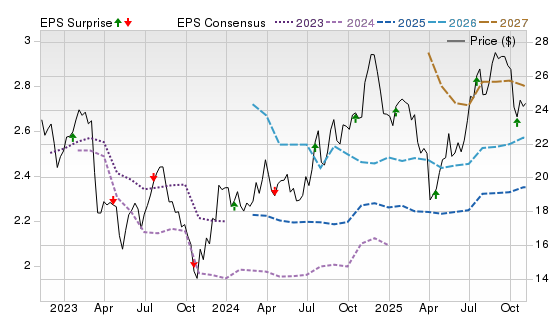
A Zacks Rank #3 with Style Scores of C for Value, F for Growth and A for Momentum presents a mixed read where price action has been better than fundamentals. The chart shows a volatile stock and a flatter, sometimes drifting-down consensus path, suggesting the market needs cleaner upward revisions to sustain gains.
This is our short term rating system that serves as a timeliness indicator for stocks over the next 1 to 3 months. How good is it? See rankings and related performance below.
The Zacks Industry Rank assigns a rating to each of the 265 X (Expanded) Industries based on their average Zacks Rank.
An industry with a larger percentage of Zacks Rank #1's and #2's will have a better average Zacks Rank than one with a larger percentage of Zacks Rank #4's and #5's.
The industry with the best average Zacks Rank would be considered the top industry (1 out of 265), which would place it in the top 1% of Zacks Ranked Industries. The industry with the worst average Zacks Rank (265 out of 265) would place in the bottom 1%.
The Zacks Sector Rank assigns a rating to each of the 16 Sectors based on their average Zacks Rank.
A sector with a larger percentage of Zacks Rank #1's and #2's will have a better average Zacks Rank than one with a larger percentage of Zacks Rank #4's and #5's.
The sector with the best average Zacks Rank would be considered the top sector (1 out of 16), which would place it in the top 1% of Zacks Ranked Sectors. The sector with the worst average Zacks Rank (16 out of 16) would place in the bottom 1%.
The Style Scores are a complementary set of indicators to use alongside the Zacks Rank. It allows the user to better focus on the stocks that are the best fit for his or her personal trading style.
The scores are based on the trading styles of Value, Growth, and Momentum. There's also a VGM Score ('V' for Value, 'G' for Growth and 'M' for Momentum), which combines the weighted average of the individual style scores into one score.
Value ScoreA
Growth ScoreA
Momentum ScoreA
VGM ScoreA
Within each Score, stocks are graded into five groups: A, B, C, D and F. As you might remember from your school days, an A, is better than a B; a B is better than a C; a C is better than a D; and a D is better than an F.
As an investor, you want to buy stocks with the highest probability of success. That means you want to buy stocks with a Zacks Rank #1 or #2, Strong Buy or Buy, which also has a Score of an A or a B in your personal trading style.
Zacks Earnings ESP (Expected Surprise Prediction) looks to find companies that have recently seen positive earnings estimate revision activity. The idea is that more recent information is, generally speaking, more accurate and can be a better predictor of the future, which can give investors an advantage in earnings season.
The technique has proven to be very useful for finding positive surprises. In fact, when combining a Zacks Rank #3 or better and a positive Earnings ESP, stocks produced a positive surprise 70% of the time, while they also saw 28.3% annual returns on average, according to our 10 year backtest.
Concentrix provides customer experience and digital transformation services for global enterprises. In fiscal Q4 2025, revenue grew year over year, backed by Communications and media as well as Banking, financial services and insurance growth. Strong adjusted free cash flow is supporting capital returns alongside debt burden reduction. The 4.37% yield is notable given a low payout ratio, leaving room for continued dividends even through a cycle.
Potential Risks
Margins can be pressured if clients slash discretionary spending or pricing tightens. High leverage can magnify downside if growth disappoints.
Forecast
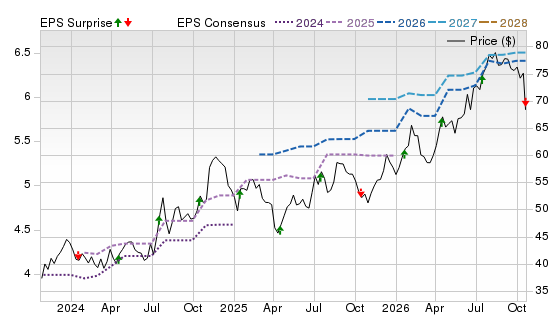
A Zacks Rank #3 with A for Value and Growth and B for Momentum signals an encouraging revision and quality blend. The chart shows a weaker price trend but a forward consensus that steps higher into 2026–2027, with surprises alternating. Sustained beats would be the catalyst for more upward estimate follow-through.
This is our short term rating system that serves as a timeliness indicator for stocks over the next 1 to 3 months. How good is it? See rankings and related performance below.
The Zacks Industry Rank assigns a rating to each of the 265 X (Expanded) Industries based on their average Zacks Rank.
An industry with a larger percentage of Zacks Rank #1's and #2's will have a better average Zacks Rank than one with a larger percentage of Zacks Rank #4's and #5's.
The industry with the best average Zacks Rank would be considered the top industry (1 out of 265), which would place it in the top 1% of Zacks Ranked Industries. The industry with the worst average Zacks Rank (265 out of 265) would place in the bottom 1%.
The Zacks Sector Rank assigns a rating to each of the 16 Sectors based on their average Zacks Rank.
A sector with a larger percentage of Zacks Rank #1's and #2's will have a better average Zacks Rank than one with a larger percentage of Zacks Rank #4's and #5's.
The sector with the best average Zacks Rank would be considered the top sector (1 out of 16), which would place it in the top 1% of Zacks Ranked Sectors. The sector with the worst average Zacks Rank (16 out of 16) would place in the bottom 1%.
The Style Scores are a complementary set of indicators to use alongside the Zacks Rank. It allows the user to better focus on the stocks that are the best fit for his or her personal trading style.
The scores are based on the trading styles of Value, Growth, and Momentum. There's also a VGM Score ('V' for Value, 'G' for Growth and 'M' for Momentum), which combines the weighted average of the individual style scores into one score.
Value ScoreA
Growth ScoreA
Momentum ScoreA
VGM ScoreA
Within each Score, stocks are graded into five groups: A, B, C, D and F. As you might remember from your school days, an A, is better than a B; a B is better than a C; a C is better than a D; and a D is better than an F.
As an investor, you want to buy stocks with the highest probability of success. That means you want to buy stocks with a Zacks Rank #1 or #2, Strong Buy or Buy, which also has a Score of an A or a B in your personal trading style.
Zacks Earnings ESP (Expected Surprise Prediction) looks to find companies that have recently seen positive earnings estimate revision activity. The idea is that more recent information is, generally speaking, more accurate and can be a better predictor of the future, which can give investors an advantage in earnings season.
The technique has proven to be very useful for finding positive surprises. In fact, when combining a Zacks Rank #3 or better and a positive Earnings ESP, stocks produced a positive surprise 70% of the time, while they also saw 28.3% annual returns on average, according to our 10 year backtest.
Euroseas owns and charters container ships, earning primarily time-charter revenue. In Q4 2025, it reported strong profitability and higher adjusted EBITDA year over year, reflecting healthy charter economics and fleet utilization. It also continued buybacks under its authorization. A 4.09% yield with a low payout ratio and robust five-year dividend growth of 11.83% suggest ample coverage when rates are supportive.
Potential Risks
Spot and charter rates can drop quickly as supply/demand shifts, and newbuild deliveries can pressure pricing. Earnings can also swing with fuel and port disruption.
Forecast
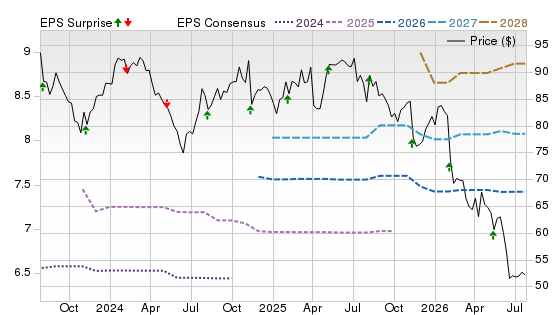
A Zacks Rank #2 (Buy) with A for Value and Momentum and D for Growth frames ESEA as inexpensive but cyclical. The chart shows a pronounced price downtrend with sparse, uneven surprise markers and a consensus line that looks cautious, implying the next re-rating likely requires clearer evidence that forward charter coverage can offset rate normalization.
The Zacks Rank is a proprietary stock-rating model that uses trends in earnings estimate revisions and earnings-per-share (EPS) surprises to classify stocks into five groups: #1 (Strong Buy), #2 (Buy), #3 (Hold), #4 (Sell) and #5 (Strong Sell). The Zacks Rank is calculated through four primary factors related to earnings estimates: analysts' consensus on earnings estimate revisions, the magnitude of revision change, the upside potential and estimate surprise (or the degree in which earnings per share deviated from the previous quarter).
Zacks builds the data from 3,000 analysts at over 150 different brokerage firms. The average yearly gain for Zacks Rank #1 (Strong Buy) stocks is +23.62% per year from January, 1988, through June 2, 2025.
For this list, only companies trading on the New York Stock Exchange or NASDAQ with a dividend yield of 4 to 6% were included. We also only evaluated stock with a low debt-to-equity ratio, as well as a conservative payout ratio and dividend growth. Only stocks with a Zacks Rank #3 (Hold) or higher were considered. All information is current as of market open, March 5, 2026.
Guide to Best Dividend Stocks
What Are Dividend Stocks?
Dividend stocks are shares of companies that return a portion of their earnings to shareholders on a regular basis. Rather than relying solely on stock price appreciation, dividend investors benefit from this income stream, which can complement long-term growth.
How Do Dividend Stocks Work?
Corporations that generate surplus cash may decide to share part of it with shareholders through dividends. The firm’s board will declare a dividend — often expressed as a dollar amount per share — and set a record date to identify eligible shareholders. On the payment date, the company sends the dividend (in cash or additional shares) to investors who held the stock on the record date.
Dividends typically come out of a company’s profits or free cash flow. To continue paying dividends, companies need consistent earnings, prudent capital allocation, and manageable debt levels.
How Often Do Dividend Stocks Pay in a Year?
Most U.S. dividend-paying companies distribute dividends quarterly (four times per year). Some firms choose semiannual or annual payments, depending on business norms or cash flow timing. What matters more than the frequency is consistency — companies that maintain or increase their dividend over time tend to instill more investor confidence.
Benefits and Risks of Dividend Stocks
Benefits:
Supplemental income stream — Dividends provide cash flow even if the stock price is flat or in decline.
Total return boost — Over long horizons, dividends have historically contributed a meaningful share of returns. (Many capital markets analyses show dividends often account for 30–50% of total equity returns.)
Downside cushion — In volatile markets, dividend income helps offset capital losses.
Sign of stability — Companies that consistently pay or increase dividends often have disciplined management and stable cash flows.
Risks:
Dividend cuts — If a company hits a rough patch, it might reduce or suspend dividends, which often leads to share price declines.
Limited growth reinvestment — High dividend payments may reduce funds available for expansion or innovation.
Interest rate competition — When bond yields rise, dividend stocks (especially those with modest growth prospects) may look less attractive in comparison.
Tax drag — Dividends are taxed (depending on account structure and holding period), which can eat into net return.
Dividend Stock ETFs vs Individual Stocks
When considering dividend exposure, investors have two main paths:
Individual dividend stocks: You pick specific companies you trust to pay and grow dividends. This gives you direct control over stocks and allows targeted allocation to sectors or themes you favor.
Dividend ETFs / mutual funds: Pools of dividend-paying stocks maintained by professional managers. These provide instant diversification, reduce individual stock risk, and simplify portfolio management.
Pros of Dividend ETFs
Automatic diversification lowers the risk of a single holding failing.
Fund managers monitor holdings and rebalance.
Easier to scale and maintain, especially for smaller portfolios.
Cons of Dividend ETFs vs Individual Stocks
Yields tend to be diluted by including lower-yielding names.
Less control over specific holdings or sector weightings.
Management fees may erode yields over time.
Many investors use a hybrid strategy: core allocation via a dividend ETF (for stability) supplemented by hand-picked individual dividend stocks for yield or growth.
How to Choose the Best Dividend Stocks
Not all dividend stocks are created equal. Here’s what to look for when evaluating candidates:
Dividend Yield
Yield = (Annual Dividend per Share) ÷ (Current Share Price). A moderate, well-supported yield (say 2 %–6 %, depending on sector) can be healthy, while extremely high yields often signal trouble (e.g. deep decline in share price)
Dividend Payout Ratio
This ratio shows what percentage of a company’s earnings are paid out as dividends. If a company distributes too much (e.g. > 80–90 %), it may lack flexibility to weather downturns. More conservative ratios (e.g. 30–60 %) often indicate room for future increases or a buffer in tough times.
Dividend Growth History
Look for firms that have steadily raised their dividends over years. A consistent upward trend signals confidence in future earnings. Dividend “Aristocrats” — firms in the S&P 500 that have raised dividends for at least 25 consecutive years — are often viewed as safer dividend picks.
Company Financial Health
Examine fundamentals:
Free cash flow and cash flow stability
Debt load and interest coverage
Profit margins
Growth prospects
Competitive advantage (moat)
A company with healthy cash flow and manageable debt is more likely to sustain and grow dividends.
Sector and Market Trends
Some sectors are inherently more dividend-friendly (utilities, consumer staples, real estate, energy) because they generate steady cash flows. Others (like high-growth tech) may pay little to none in dividends as they reinvest heavily.
Also consider macro conditions — for example, rising interest rates, inflation pressures, regulatory risks — which may disproportionately affect certain sectors.
Tips for Building a Dividend Portfolio
Start with a foundation of blue-chip dividend stocks — Established companies with strong balance sheets and long payout histories.
Diversify across sectors — Avoid being overly concentrated in one industry (e.g. energy or REITs).
Reinvest dividends — Using a Dividend Reinvestment Plan (DRIP) can compound returns over time.
Allocate some portion to growth or higher-yield names, if your risk tolerance allows — but don’t let them dominate.
Review and rebalance periodically — Monitor fundamentals, payout changes, valuation shifts, and sector dynamics.
Use metrics and screening tools — Apply filters (yield, payout ratios, growth, fundamentals) to narrow your universe, then do deeper research.
Mistakes to Avoid about Dividend Stocks
Chasing the highest yield blindly — extremely high yields can indicate a distressed company or impending cuts.
Ignoring payout sustainability — yield without coverage (earnings, cash flow) is precarious.
Overconcentration in one stock or sector — a dividend cut or sector downturn can deeply hurt.
Neglecting growth potential — pure high-yield stocks may underperform in growth cycles.
Forgetting taxes and fees — dividends taxed or fees eroding yield can reduce net returns.
Also, be cautious if yield spikes because of falling share price — that could be a warning sign rather than opportunity.
Frequently Asked Questions About Dividend Stocks
How are dividends taxed?
In the U.S., qualified dividends (if holding periods are met) are taxed at long-term capital gains rates (0 %, 15 %, or 20 %, depending on income bracket). Non-qualified dividends are taxed at ordinary income rates. Additionally, when you sell shares, capital gains taxes may apply to the appreciation portion.
Are dividend stocks good for retirees?
Yes. They can provide a predictable stream of income and may buffer volatility. However, retirees should emphasize safety and sustainability — favor those with strong balance sheets, stable business models, and moderate payout ratios. Also, be aware of tax effects and inflation.
What’s a good dividend yield?
There’s no one “ideal” yield. Many investors view 2 %–6 % as reasonable, depending on the sector and interest rate environment. Yields well above that range warrant extra scrutiny — high yields often come with higher risk.
Are dividend stocks safe for beginners?
They can be, especially when you start with well-known, financially sound dividend payers and diversify. The income cushion helps offset downside risk. But beginners must still research fundamentals, avoid yield traps, and avoid overconcentration.