We use cookies to understand how you use our site and to improve your experience.
This includes personalizing content and advertising.
By pressing "Accept All" or closing out of this banner, you consent to the use of all cookies and similar technologies and the sharing of information they collect with third parties.
You can reject marketing cookies by pressing "Deny Optional," but we still use essential, performance, and functional cookies.
In addition, whether you "Accept All," Deny Optional," click the X or otherwise continue to use the site, you accept our Privacy Policy and Terms of Service, revised from time to time.
You are being directed to ZacksTrade, a division of LBMZ Securities and licensed broker-dealer. ZacksTrade and Zacks.com are separate companies. The web link between the two companies is not a solicitation or offer to invest in a particular security or type of security. ZacksTrade does not endorse or adopt any particular investment strategy, any analyst opinion/rating/report or any approach to evaluating individual securities.
If you wish to go to ZacksTrade, click OK. If you do not, click Cancel.
Biotech stocks combine scientific innovation with substantial R&D investment in cutting edge medicine.
Biotech sector includes companies focused on gene editing and breakthroughs in rare disease treatment.
Biotech stocks are higher risk, but with higher potential for reward for companies that succeed.
The biotech sector continues to draw intense investor interest — from innovation in gene editing and mRNA to breakthroughs in rare disease therapies. But with high risk comes high reward, and separating long-term winners from speculative bets is more important than ever.
Are Biotech Stocks a Good Investment Long-Term?
Biotech companies can deliver extraordinary upside when their clinical programs succeed — but the path is fraught. Long-term investing in biotech often hinges on believing in a company’s pipeline, cash runway and capacity to navigate regulatory hurdles. Many top biotechs have matured past early-stage risk, with commercial revenues and established R&D engines, making them more resilient in volatile markets.
Meanwhile, broader trends like aging populations, precision medicine, and platform technologies (like gene therapy and mRNA) bolster the long-term case. However, interest rate swings, clinical failures and capital burn remain real threats. For investors with sufficient time horizon and risk tolerance, biotechs offer a compelling opportunity.
Here, we analyze and rank the best biotech stocks to buy now ranked on a blend Zacks Rank signals, Style Scores and fundamentals:
This is our short term rating system that serves as a timeliness indicator for stocks over the next 1 to 3 months. How good is it? See rankings and related performance below.
The Zacks Industry Rank assigns a rating to each of the 265 X (Expanded) Industries based on their average Zacks Rank.
An industry with a larger percentage of Zacks Rank #1's and #2's will have a better average Zacks Rank than one with a larger percentage of Zacks Rank #4's and #5's.
The industry with the best average Zacks Rank would be considered the top industry (1 out of 265), which would place it in the top 1% of Zacks Ranked Industries. The industry with the worst average Zacks Rank (265 out of 265) would place in the bottom 1%.
The Zacks Sector Rank assigns a rating to each of the 16 Sectors based on their average Zacks Rank.
A sector with a larger percentage of Zacks Rank #1's and #2's will have a better average Zacks Rank than one with a larger percentage of Zacks Rank #4's and #5's.
The sector with the best average Zacks Rank would be considered the top sector (1 out of 16), which would place it in the top 1% of Zacks Ranked Sectors. The sector with the worst average Zacks Rank (16 out of 16) would place in the bottom 1%.
The Style Scores are a complementary set of indicators to use alongside the Zacks Rank. It allows the user to better focus on the stocks that are the best fit for his or her personal trading style.
The scores are based on the trading styles of Value, Growth, and Momentum. There's also a VGM Score ('V' for Value, 'G' for Growth and 'M' for Momentum), which combines the weighted average of the individual style scores into one score.
Value ScoreA
Growth ScoreA
Momentum ScoreA
VGM ScoreA
Within each Score, stocks are graded into five groups: A, B, C, D and F. As you might remember from your school days, an A, is better than a B; a B is better than a C; a C is better than a D; and a D is better than an F.
As an investor, you want to buy stocks with the highest probability of success. That means you want to buy stocks with a Zacks Rank #1 or #2, Strong Buy or Buy, which also has a Score of an A or a B in your personal trading style.
Zacks Earnings ESP (Expected Surprise Prediction) looks to find companies that have recently seen positive earnings estimate revision activity. The idea is that more recent information is, generally speaking, more accurate and can be a better predictor of the future, which can give investors an advantage in earnings season.
The technique has proven to be very useful for finding positive surprises. In fact, when combining a Zacks Rank #3 or better and a positive Earnings ESP, stocks produced a positive surprise 70% of the time, while they also saw 28.3% annual returns on average, according to our 10 year backtest.
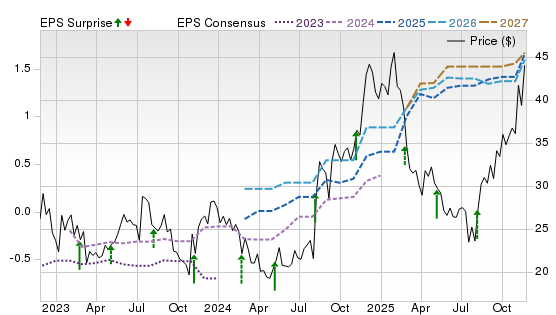
ADMA’s story is simple, build more, waste less, and sell into a demand base that does not disappear. In Q4 2025, it wrapped a record year with 2025 revenue up 20% and adjusted EBITDA up 40% versus 2024, powered by ASCENIV and improving scale benefits. Now the catalyst is operational: yield gains and capacity expansion that can steadily push margins higher as production grows.
Potential Risks
Plasma collection and biologics manufacturing are unforgiving; any supply disruption, batch issue, or FDA observation can hit shipments and costs. Results are product-concentrated, and competitive pricing or payer resistance to ASCENIV could slow adoption.
Forecast
A Zacks Rank #1 (Strong Buy) with a Momentum Score of A signals supportive estimate revisions and price action, even with a Value Score of D. The Price, Consensus & EPS Surprise chart shows 2026–2027 EPS consensus stair-stepping higher and mostly positive surprises since 2024, a setup that can keep estimates drifting up if execution stays clean.
This is our short term rating system that serves as a timeliness indicator for stocks over the next 1 to 3 months. How good is it? See rankings and related performance below.
The Zacks Industry Rank assigns a rating to each of the 265 X (Expanded) Industries based on their average Zacks Rank.
An industry with a larger percentage of Zacks Rank #1's and #2's will have a better average Zacks Rank than one with a larger percentage of Zacks Rank #4's and #5's.
The industry with the best average Zacks Rank would be considered the top industry (1 out of 265), which would place it in the top 1% of Zacks Ranked Industries. The industry with the worst average Zacks Rank (265 out of 265) would place in the bottom 1%.
The Zacks Sector Rank assigns a rating to each of the 16 Sectors based on their average Zacks Rank.
A sector with a larger percentage of Zacks Rank #1's and #2's will have a better average Zacks Rank than one with a larger percentage of Zacks Rank #4's and #5's.
The sector with the best average Zacks Rank would be considered the top sector (1 out of 16), which would place it in the top 1% of Zacks Ranked Sectors. The sector with the worst average Zacks Rank (16 out of 16) would place in the bottom 1%.
The Style Scores are a complementary set of indicators to use alongside the Zacks Rank. It allows the user to better focus on the stocks that are the best fit for his or her personal trading style.
The scores are based on the trading styles of Value, Growth, and Momentum. There's also a VGM Score ('V' for Value, 'G' for Growth and 'M' for Momentum), which combines the weighted average of the individual style scores into one score.
Value ScoreA
Growth ScoreA
Momentum ScoreA
VGM ScoreA
Within each Score, stocks are graded into five groups: A, B, C, D and F. As you might remember from your school days, an A, is better than a B; a B is better than a C; a C is better than a D; and a D is better than an F.
As an investor, you want to buy stocks with the highest probability of success. That means you want to buy stocks with a Zacks Rank #1 or #2, Strong Buy or Buy, which also has a Score of an A or a B in your personal trading style.
Zacks Earnings ESP (Expected Surprise Prediction) looks to find companies that have recently seen positive earnings estimate revision activity. The idea is that more recent information is, generally speaking, more accurate and can be a better predictor of the future, which can give investors an advantage in earnings season.
The technique has proven to be very useful for finding positive surprises. In fact, when combining a Zacks Rank #3 or better and a positive Earnings ESP, stocks produced a positive surprise 70% of the time, while they also saw 28.3% annual returns on average, according to our 10 year backtest.
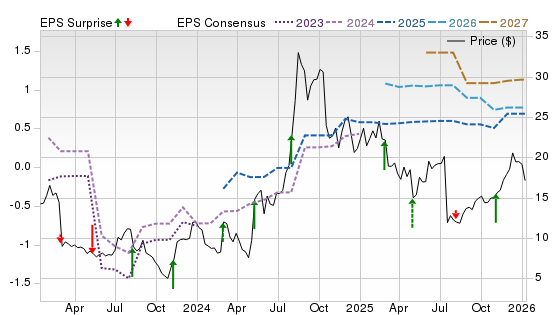
Catalyst is a rare-disease biotech with an established neuromuscular franchise led by FIRDAPSE and newer growth from AGAMREE. In Q4 2025, it posted record quarterly revenue and another record year, and 2026 revenue guidance signals durable demand across the portfolio. Strong profitability and cash generation give Catalyst flexibility for lifecycle investments, targeted business development, and shareholder returns.
Potential Risks
Revenue concentration is meaningful, and competitive dynamics, especially around epilepsy product FYCOMPA, can pressure pricing and volumes. Any disruption in specialty distribution, payer access, or rare-disease patient identification could quickly show up in results.
Forecast
A Zacks Rank #1 suggests favorable earnings revisions, while a Value Score of A implies the market is not paying peak multiples; a Momentum Score of B is supportive. The chart shows 2026–2027 EPS consensus stepping higher with more recent beats than misses, a pattern that can keep estimates drifting up if execution stays steady.
This is our short term rating system that serves as a timeliness indicator for stocks over the next 1 to 3 months. How good is it? See rankings and related performance below.
The Zacks Industry Rank assigns a rating to each of the 265 X (Expanded) Industries based on their average Zacks Rank.
An industry with a larger percentage of Zacks Rank #1's and #2's will have a better average Zacks Rank than one with a larger percentage of Zacks Rank #4's and #5's.
The industry with the best average Zacks Rank would be considered the top industry (1 out of 265), which would place it in the top 1% of Zacks Ranked Industries. The industry with the worst average Zacks Rank (265 out of 265) would place in the bottom 1%.
The Zacks Sector Rank assigns a rating to each of the 16 Sectors based on their average Zacks Rank.
A sector with a larger percentage of Zacks Rank #1's and #2's will have a better average Zacks Rank than one with a larger percentage of Zacks Rank #4's and #5's.
The sector with the best average Zacks Rank would be considered the top sector (1 out of 16), which would place it in the top 1% of Zacks Ranked Sectors. The sector with the worst average Zacks Rank (16 out of 16) would place in the bottom 1%.
The Style Scores are a complementary set of indicators to use alongside the Zacks Rank. It allows the user to better focus on the stocks that are the best fit for his or her personal trading style.
The scores are based on the trading styles of Value, Growth, and Momentum. There's also a VGM Score ('V' for Value, 'G' for Growth and 'M' for Momentum), which combines the weighted average of the individual style scores into one score.
Value ScoreA
Growth ScoreA
Momentum ScoreA
VGM ScoreA
Within each Score, stocks are graded into five groups: A, B, C, D and F. As you might remember from your school days, an A, is better than a B; a B is better than a C; a C is better than a D; and a D is better than an F.
As an investor, you want to buy stocks with the highest probability of success. That means you want to buy stocks with a Zacks Rank #1 or #2, Strong Buy or Buy, which also has a Score of an A or a B in your personal trading style.
Zacks Earnings ESP (Expected Surprise Prediction) looks to find companies that have recently seen positive earnings estimate revision activity. The idea is that more recent information is, generally speaking, more accurate and can be a better predictor of the future, which can give investors an advantage in earnings season.
The technique has proven to be very useful for finding positive surprises. In fact, when combining a Zacks Rank #3 or better and a positive Earnings ESP, stocks produced a positive surprise 70% of the time, while they also saw 28.3% annual returns on average, according to our 10 year backtest.
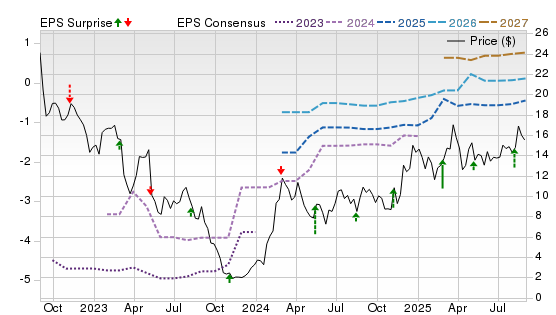
CareDx sells diagnostic tests and software for transplant monitoring, giving it biotech exposure to a specialized, high-acuity clinical workflow. In Q4 2025, it delivered 14% full-year revenue growth and guided to $420–$444 million for 2026, signaling momentum in its transplant portfolio and improved operational focus. With clinicians increasingly relying on molecular surveillance, incremental scale can translate into better margins over time.
Potential Risks
Reimbursement and coverage decisions are pivotal, and any payer pushback on medical necessity or pricing could hit volumes. CareDx also faces diagnostics competition, and litigation or regulatory scrutiny can raise costs and distract management.
Forecast
A Zacks Rank #3 (Hold) is a neutral revisions signal, but the Growth Score of A points to improving expectations. The chart shows 2026–2027 EPS consensus trending steadily higher from losses toward profitability while surprises remain mixed, suggesting estimates may stay volatile until results turn consistently positive.
This is our short term rating system that serves as a timeliness indicator for stocks over the next 1 to 3 months. How good is it? See rankings and related performance below.
The Zacks Industry Rank assigns a rating to each of the 265 X (Expanded) Industries based on their average Zacks Rank.
An industry with a larger percentage of Zacks Rank #1's and #2's will have a better average Zacks Rank than one with a larger percentage of Zacks Rank #4's and #5's.
The industry with the best average Zacks Rank would be considered the top industry (1 out of 265), which would place it in the top 1% of Zacks Ranked Industries. The industry with the worst average Zacks Rank (265 out of 265) would place in the bottom 1%.
The Zacks Sector Rank assigns a rating to each of the 16 Sectors based on their average Zacks Rank.
A sector with a larger percentage of Zacks Rank #1's and #2's will have a better average Zacks Rank than one with a larger percentage of Zacks Rank #4's and #5's.
The sector with the best average Zacks Rank would be considered the top sector (1 out of 16), which would place it in the top 1% of Zacks Ranked Sectors. The sector with the worst average Zacks Rank (16 out of 16) would place in the bottom 1%.
The Style Scores are a complementary set of indicators to use alongside the Zacks Rank. It allows the user to better focus on the stocks that are the best fit for his or her personal trading style.
The scores are based on the trading styles of Value, Growth, and Momentum. There's also a VGM Score ('V' for Value, 'G' for Growth and 'M' for Momentum), which combines the weighted average of the individual style scores into one score.
Value ScoreA
Growth ScoreA
Momentum ScoreA
VGM ScoreA
Within each Score, stocks are graded into five groups: A, B, C, D and F. As you might remember from your school days, an A, is better than a B; a B is better than a C; a C is better than a D; and a D is better than an F.
As an investor, you want to buy stocks with the highest probability of success. That means you want to buy stocks with a Zacks Rank #1 or #2, Strong Buy or Buy, which also has a Score of an A or a B in your personal trading style.
Zacks Earnings ESP (Expected Surprise Prediction) looks to find companies that have recently seen positive earnings estimate revision activity. The idea is that more recent information is, generally speaking, more accurate and can be a better predictor of the future, which can give investors an advantage in earnings season.
The technique has proven to be very useful for finding positive surprises. In fact, when combining a Zacks Rank #3 or better and a positive Earnings ESP, stocks produced a positive surprise 70% of the time, while they also saw 28.3% annual returns on average, according to our 10 year backtest.
Arcutis is a commercial-stage dermatology biotech built around ZORYVE (roflumilast) across inflammatory skin diseases. In Q4 2025, ZORYVE net product sales rose 29% sequentially and 84% year over year, and management raised 2026 revenue guidance, underscoring improving demand and gross-to-net execution. As the franchise broadens, Arcutis is gaining operating leverage in large, chronic markets.
Potential Risks
Dermatology is crowded, and promotional intensity, rebates, or formulary access can swing growth rates. Arcutis is still investing heavily, so any stumble in launch execution or slower uptake could extend cash burn and pressure valuation.
Forecast
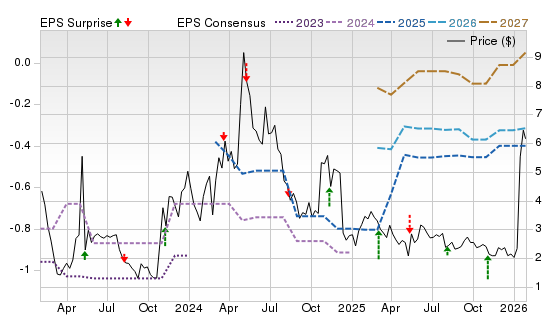
A Zacks Rank #3 is a hold signal, but the Growth Score of A points to strong expectations; the Momentum Score of D warns the stock may be news-sensitive. The chart shows multi-year EPS loss estimates narrowing into 2026–2027 with mostly positive surprises in 2025, suggesting revisions can improve if demand stays on track.
This is our short term rating system that serves as a timeliness indicator for stocks over the next 1 to 3 months. How good is it? See rankings and related performance below.
The Zacks Industry Rank assigns a rating to each of the 265 X (Expanded) Industries based on their average Zacks Rank.
An industry with a larger percentage of Zacks Rank #1's and #2's will have a better average Zacks Rank than one with a larger percentage of Zacks Rank #4's and #5's.
The industry with the best average Zacks Rank would be considered the top industry (1 out of 265), which would place it in the top 1% of Zacks Ranked Industries. The industry with the worst average Zacks Rank (265 out of 265) would place in the bottom 1%.
The Zacks Sector Rank assigns a rating to each of the 16 Sectors based on their average Zacks Rank.
A sector with a larger percentage of Zacks Rank #1's and #2's will have a better average Zacks Rank than one with a larger percentage of Zacks Rank #4's and #5's.
The sector with the best average Zacks Rank would be considered the top sector (1 out of 16), which would place it in the top 1% of Zacks Ranked Sectors. The sector with the worst average Zacks Rank (16 out of 16) would place in the bottom 1%.
The Style Scores are a complementary set of indicators to use alongside the Zacks Rank. It allows the user to better focus on the stocks that are the best fit for his or her personal trading style.
The scores are based on the trading styles of Value, Growth, and Momentum. There's also a VGM Score ('V' for Value, 'G' for Growth and 'M' for Momentum), which combines the weighted average of the individual style scores into one score.
Value ScoreA
Growth ScoreA
Momentum ScoreA
VGM ScoreA
Within each Score, stocks are graded into five groups: A, B, C, D and F. As you might remember from your school days, an A, is better than a B; a B is better than a C; a C is better than a D; and a D is better than an F.
As an investor, you want to buy stocks with the highest probability of success. That means you want to buy stocks with a Zacks Rank #1 or #2, Strong Buy or Buy, which also has a Score of an A or a B in your personal trading style.
Zacks Earnings ESP (Expected Surprise Prediction) looks to find companies that have recently seen positive earnings estimate revision activity. The idea is that more recent information is, generally speaking, more accurate and can be a better predictor of the future, which can give investors an advantage in earnings season.
The technique has proven to be very useful for finding positive surprises. In fact, when combining a Zacks Rank #3 or better and a positive Earnings ESP, stocks produced a positive surprise 70% of the time, while they also saw 28.3% annual returns on average, according to our 10 year backtest.
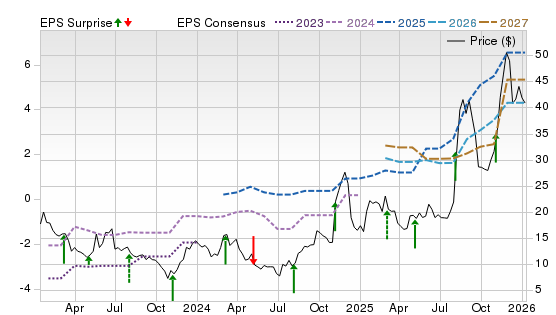
Rigel is a commercial biotech focused on hematology and oncology, with revenue anchored by TAVALISSE and complemented by GAVRETO and REZLIDHIA. In Q4 2025, it reported record net product sales and positive full-year profitability, highlighting improved commercial execution and a more diversified base than in prior years. Pipeline work, including R289 in MDS, adds optionality without needing a binary catalyst.
Potential Risks
Some recent net income reflects non-cash tax benefits, so investors should track underlying operating trends. Sales can be sensitive to competitive therapy shifts and partner execution, while pipeline readouts still carry clinical and regulatory risk.
Forecast
A Zacks Rank #3 is neutral, but a Value Score of A and a Momentum Score of A, plus a VGM Score of A, point to an attractive setup. The chart shows 2026–2027 EPS consensus rising with many beats through 2025, though the latest miss and a post-spike price pullback suggest expectations may be resetting.
The Zacks Rank is a proprietary stock-rating model that uses trends in earnings estimate revisions and earnings-per-share (EPS) surprises to classify stocks into five groups: #1 (Strong Buy), #2 (Buy), #3 (Hold), #4 (Sell) and #5 (Strong Sell). The Zacks Rank is calculated through four primary factors related to earnings estimates: analysts' consensus on earnings estimate revisions, the magnitude of revision change, the upside potential and estimate surprise (or the degree in which earnings per share deviated from the previous quarter).
Zacks builds the data from 3,000 analysts at over 150 different brokerage firms. The average yearly gain for Zacks Rank #1 (Strong Buy) stocks is +23.62% per year from January, 1988, through June 2, 2025.
Selections for Best Biotech Stocks are based on the current top ranking stocks based on Zacks Indicator Score, Style Scores and fundamentals. For this list, only companies that have average daily trading volumes of 100,000 shares or more of 135 biotech companies listed on the New York Stock Exchange or Nasdaq. All information is current as of market open, March 19, 2026.
General Biotech Investment Questions
What Are Biotech Stocks?
Biotech stocks are shares of companies that use biological systems and organisms to develop new drugs, therapies, and diagnostics. These firms invest heavily in research & development and often carry greater risk than traditional pharmaceutical companies.
Therapeutic biotechs: Develop specific drug candidates (e.g., rare disease, oncology).
Service biotechs: Provide research tools, reagents, or contract research services.
What Are the Benefits of Buying Biotech Stocks?
High upside: Successful trials or approvals can lead to big gains.
Innovative exposure: Access to cutting-edge science (e.g., gene therapy).
Diversification: Biotech can be a non-cyclical growth lever in a portfolio.
Partnering potential: Smaller biotech firms are often acquired by larger pharma.
What Are the Risks of Buying Biotech Stocks?
Clinical risk: Many drugs fail in trials
Cash burn: R&D is expensive, and many biotechs depend on funding.
Regulatory risk: FDA decisions can make or break a company.
Volatility: Stock prices swing wildly on news.
Biotech Stocks vs. Biotech ETFs
Stocks: Higher potential reward, but higher risk and volatility
ETFs: Diversified exposure, smoother ride, less binary outcomes
Which is right depends on your risk tolerance and conviction in individual companies.
Why Are Biotech Stocks So Volatile?
Clinical trial outcomes are binary (success/failure).
Regulatory approvals depend on strict criteria.
Biotechs often raise capital, diluting shareholders.
News-driven: trial results, partnership deals, or FDA news can swing sentiment.
Is It Too Late to Invest in Biotech Stocks?
Not necessarily. While some biotechs (especially large-caps) may look fully valued, many smaller, clinical-stage companies still offer asymmetric upside. Plus, emerging trends — gene editing, synthetic biology, AI-driven drug discovery — continue to open new frontiers.
Best Biotech ETFs
Not all investors want to take on the risk of single biotechs. Below are some top ETFs that offer diversified exposure:
iShares Biotechnology ETF (IBB): Focuses on large-cap biotech names, offering lower volatility compared to smaller biotechs.
SPDR S&P Biotech ETF (XBI): Equal-weighted, which means more exposure to mid- and small-cap biotech companies — higher risk, potentially higher reward.
VanEck Biotech ETF (BBH): Concentrated in major pure-play biotech names.
These ETFs help mitigate the binary risk inherent in individual biotech names by spreading exposure across many companies.
Biotech Stocks Trends and Forecast
What Biotech Stocks Could Benefit from New FDA Approvals?
Sarepta (SRPT): Pipeline in DMD and other neuromuscular disorders.
Beam (BEAM): Base-editing therapies could attract regulatory attention as clinical data matures.
Arcellx: Its CAR-T programs (e.g., anito-cel) could hit registrational milestones soon.
Which Biotech Firms Are Leading in Gene Editing or mRNA?
What Are the Most Promising Biotech Trends for 2025/2026?
Base editing and next-gen CRISPR.
Synthetic biology for therapeutics.
Precision medicine for rare diseases.
AI-driven drug discovery.
Cell and gene therapies for “undruggable” conditions.
How Does Interest Rate Policy Affect Biotech Valuations?
Higher interest rates make future cash flows less valuable, which disproportionately affects pre-commercial biotech companies. Biotechs with strong cash reserves, recurring revenues, or partnerships may weather a high-rate environment better than early-stage names.
What Startups Could Be the Next Big Biotech Breakout?
Some emerging companies to watch include those in base editing (like Beam) or synthetic biology (like Twist Bioscience). Also, small gene therapy firms that prove safety and efficacy could be acquisition targets.
How to Select Biotech Stocks
How to Evaluate a Biotech Company’s Pipeline
Examine clinical trial phases and data (Phase 1–3).
Check regulatory designations (Orphan, Fast Track, Breakthrough).
Assess manufacturing strategy (can they scale?)
Review partnerships with big pharma.
What Financial Metrics Should I Look at When Selecting Biotech Stocks?
Cash runway — Months until they need to raise capital.
Burn rate — How fast they spend R&D cash?
Debt levels — To help understand leverage risk.
Revenue sources — If any (e.g., royalties, partnerships).
Valuation multiples — P/E for commercial companies, or price-to-cash for R&D firms.
Which Biotech Companies Are Using AI for Drug Discovery?
Several biotech firms now leverage AI to speed up target identification, optimize molecules, and predict clinical success. While specific names vary, more platform-focused biotechs (especially in synthetic biology and precision medicine) are adopting AI broadly.
Advanced or Thematic Biotech Investing
Best Gene Therapy, Immunotherapy, or Synthetic Biology Stocks
Companies combining AI with biology to accelerate drug development are particularly exciting. Though many remain private, public players using AI in drug discovery or platform development may include synthetic biology firms and next-gen therapeutic companies.
Small-Cap vs. Large-Cap Biotech Investing Strategies
Small-Cap: Higher risk/reward; ideal for speculative, event-driven plays.
Large-Cap: More stability, some revenue streams, diversified pipelines.
Balanced Approach: Use ETFs for broad exposure + pick 1–2 individual names for high conviction.
How FDA Approval Cycles Impact Biotech Valuations
Each clinical milestone (Phase 2 readout, Phase 3 initiation, NDA/BLA filing) can trigger major revaluations. Investors often build models around key FDA dates, trial data, and partner commitments. Failure or delay can lead to steep losses; success can lead to multi-bagger returns.