
5 Best Small-Cap Stocks to Buy Today
| Company (Ticker) | 12 Week Price Change | Forward PE | Price | Proj EPS Growth (1 Year) | Projected Sales Growth (1Y) |
|---|---|---|---|---|---|
| Forum Energy Technologies (FET) | 30.14% | 24.95 | $41.71 | 197.27% | 2.75% |
| Array Technologies (ARRY) | 10.50% | 10.23 | $10.00 | 44.62% | 18.38% |
| Harrow, Inc. (HROW) | 24.21% | 31.32 | $48.36 | 1,991.89% | 42.42% |
| Five9 (FIVN) | -17.42% | 5.94 | $17.98 | 8.72% | 9.65% |
| GigaCloud Technology Inc. (GCT) | 49.62% | 11.88 | $41.13 | 9.37% | 12.44% |
*Updated on January 16, 2026.
Forum Energy Technologies (FET)
$41.71 USD +0.91 (2.23%)
3-Year Stock Price Performance
Premium Research for FET
- Zacks Rank
Strong Buy 1
- Style Scores
C Value A Growth C Momentum A VGM
- Market Cap:$464.22 M
- Projected EPS Growth:163.95%
- Last Quarter EPS Growth:370.00%
- Last EPS Surprise:42.11%
- Next EPS Report date:Feb. 19, 2026
Our Take:
Forum Energy sells oilfield products and services spanning drilling, completions, and production. Its market cap is $464.2 million. A Zacks Rank #1 (Strong Buy) reflects positive estimate revisions, while Style Scores of A for Growth offset middling C for Value and Momentum, suggesting improving fundamentals with a still-reasonable setup.
Latest results showed resilient execution: FET posted Q3 2025 revenue of $196 million and positive adjusted net income, and raised full-year free-cash-flow guidance, evidence that cost actions and portfolio focus are taking hold despite cyclical headwinds. With exposure across upstream categories, the company remains leveraged to international and offshore activity without relying on any single basin.
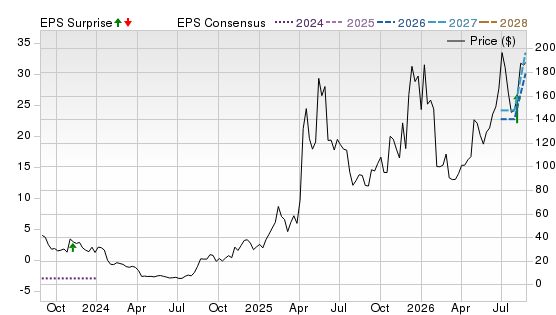
On the Price, Consensus & EPS Surprise chart, the flat price base contrasts with gradually stabilizing outer-year EPS lines after a steep reset, a pattern consistent with the company’s improving cash-generation outlook. This underpins a cautious but constructive small-cap energy thesis.
Array Technologies (ARRY)
$10.00 USD +0.11 (1.11%)
3-Year Stock Price Performance
Premium Research for ARRY
- Zacks Rank
Strong Buy 1
- Style Scores
B Value B Growth D Momentum B VGM
- Market Cap:$1.51 B
- Projected EPS Growth:11.67%
- Last Quarter EPS Growth:17.39%
- Last EPS Surprise:42.86%
- Next EPS Report date:Feb. 26, 2026
Our Take:
Array Technologies makes single-axis solar trackers used in utility-scale projects. The company’s market cap is roughly $1.5 billion. A Zacks Rank #1, paired with Style Scores of B for Value and Growth and D for Momentum, indicates favorable estimate revisions and reasonable valuation despite weak near-term momentum.
Array delivered Q3 revenue of $393.5 million and achieved an adjusted gross margin of 28.1%, while increasing full-year 2025 revenue guidance to $1.25-$1.28 billion. The APA acquisition was completed last August, bringing significant commercial synergies. Execution on 100% domestic-content trackers and product mix should help manage tariff and supply constraints.
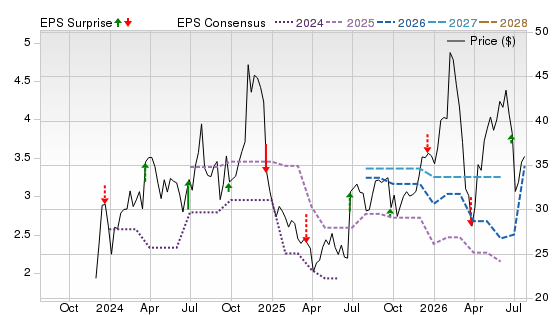
The chart shows a recent price rebound alongside rising 2026–27 consensus lines after a trough, aligning with the estimate revision trend and supporting a measured recovery narrative as project timelines normalize. Its $1.9 billion order book, with more than 95% domestic projects, makes it a lucrative small-cap solar pick.
Harrow, Inc. (HROW)
$48.36 USD -0.13 (-0.27%)
3-Year Stock Price Performance
Premium Research for HROW
- Zacks Rank
Strong Buy 1
- Style Scores
D Value A Growth D Momentum B VGM
- Market Cap:$1.80 B
- Projected EPS Growth:117.95%
- Last Quarter EPS Growth:37.50%
- Last EPS Surprise:50.00%
- Next EPS Report date:March 26, 2026
Our Take:
Harrow is a North American ophthalmic-pharma company commercializing branded eye-care drugs. It carries a market cap of $1.8 billion. A Zacks Rank #1 with a Style Score of A for Growth highlights strong estimate revisions, while weaker Value and Momentum Scores of D reflect recent volatility.
The third quarter 2025 revenue rose 45% to $71.6 million, and core gross margin jumped to 81%, driven by the accelerating uptake of IHEEZO and VEVYE. The Melt Pharmaceuticals acquisition of November 2025 has boosted HROW’s portfolio, expanding its footprint in outpatient procedures. The launch of Harrow Access for All is expected to reinforce its multi-product penetration over the long term.
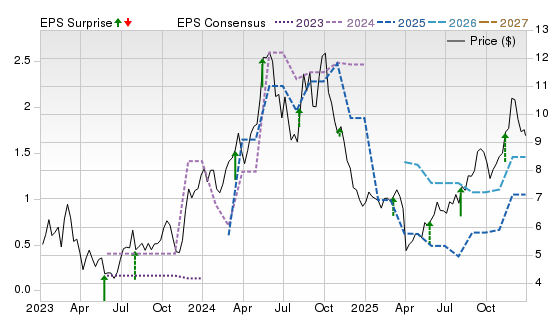
On the chart, shares corrected even as the outer-year consensus has trended higher, a divergence that sets up potential estimate-led catch-up. That dynamic, together with rising branded-mix contributions, supports the Rank signal while keeping expectations balanced.
Five9 (FIVN)
$17.98 USD -1.03 (-5.42%)
3-Year Stock Price Performance
Premium Research for FIVN
- Zacks Rank
Strong Buy 1
- Style Scores
A Value A Growth D Momentum A VGM
- Market Cap:$1.49 B
- Projected EPS Growth:19.03%
- Last Quarter EPS Growth:37.93%
- Last EPS Surprise:6.85%
- Next EPS Report date:Feb. 19, 2026
Our Take:
Five9 provides cloud contact-center software with embedded AI and has a market cap of around $1.5 billion. A Zacks Rank #1 with Style Scores of A for Value and Growth and D for Momentum, captures broad-based estimate support as fundamentals improve.
In the third quarter of 2025, Five9 reported $285.8 million in revenue, reached a 25.1% adjusted EBITDA margin, and generated a record operating cash flow of $59.2 million. AI revenue grew 41% and now represents 11% of subscription revenue, underscoring product differentiation and large-deal traction. Guidance called for continued margin expansion alongside steady top-line growth. Its financial flexibility enables prudent investments and share repurchases.
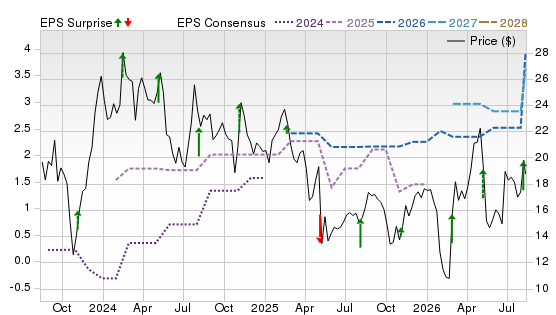
The chart shows price volatility, but the 2026–27 consensus lines have drifted higher, consistent with improving mix and cash discipline. That estimate momentum underpins the Rank and supports a quality-at-a-discount small-cap setup with high customer retention, despite choppy sentiment.
GigaCloud Technology Inc. (GCT)
$41.13 USD -0.45 (-1.08%)
3-Year Stock Price Performance
Premium Research for GCT
- Zacks Rank
- Strong Buy 1
- Style Scores
A Value B Growth D Momentum A VGM
- Market Cap:$1.54 B
- Projected EPS Growth:4.92%
- Last Quarter EPS Growth:8.79%
- Last EPS Surprise:52.31%
- Next EPS Report date:March 2, 2026
Our Take:
GigaCloud runs a B2B e-commerce and logistics platform for large-parcel goods, with a market cap of above $1.5 billion. A Zacks Rank #1 and Style Scores of A for Value, B for Growth and D for Momentum reflect favorable revisions and attractive valuation, despite softer momentum.
In Q3 2025, GCT generated $332.6 million in revenue with 9.7% year-over-year growth, expanded marketplace GMV, and exited the quarter debt-free with over $334.9 million in cash balance. While Q3 margin was slightly compressed on mix and investments, profitability remained solid and management highlighted continued expansion and platform scale. The New Classic Home Furnishings acquisition in January 2026 expanded its retailer customer network.
On the chart, the sharp price recovery coincides with firming 2026–27 consensus, suggesting expectations are resetting higher after volatility. With balance-sheet strength and a growing third-party ecosystem, estimate momentum supports the Rank while leaving room for disciplined execution.
Methodology
The Zacks Rank is a proprietary stock-rating model that uses trends in earnings estimate revisions and earnings-per-share (EPS) surprises to classify stocks into five groups: #1 (Strong Buy), #2 (Buy), #3 (Hold), #4 (Sell) and #5 (Strong Sell). The Zacks Rank is calculated through four primary factors related to earnings estimates: analysts' consensus on earnings estimate revisions, the magnitude of revision change, the upside potential and estimate surprise (or the degree in which earnings per share deviated from the previous quarter).
Zacks builds the data from 3,000 analysts at over 150 different brokerage firms. The average yearly gain for Zacks Rank #1 (Strong Buy) stocks is +23.62% per year from January, 1988, through June 2, 2025.
For this list, only companies trading 100,000 shares or more daily and in the top 50% of industries were considered. All stocks had a Zacks Rank #1 rank at the time of selection. All information is current as of market open, Jan. 16, 2026.
Guide to Best Small-Cap Stocks
What Are Small-Cap Stocks?
“Small-cap” refers to publicly traded companies whose market capitalisation falls below a certain threshold. The exact cutoff varies by region or index provider, but commonly in the U.S. small-caps are defined as roughly $300 million to $2 billion in market cap.
Why Invest in Small-Cap Stocks
- Growth potential: Because these companies are smaller, they have more runway to grow revenues, profits and market share.
- Diversification: They often behave differently than large-cap stocks, so including them can enhance portfolio diversification.
- Value opportunity: Many small-caps are currently trading at valuations below historical norms or relative to large caps — offering potential mispricing opportunities.
Small-Cap vs Mid-Cap vs Large-Cap Stocks
Small Cap:
- Market capitalization of between $300 million to $2 billion (but designation can vary among indices).
- Higher growth potential, but higher risk and less liquidity.
- More volatile and more sensitive to economic and interest rate shifts.
Medium (Mid) Cap:
- Market capitalization generally from $2 billion to $10 billion.
- Balanced between growth and stability.
- Fewer extremes than small caps, but possibly less upside.
Large Cap:
- Market cap is usually over $10 billion.
- Established companies, lower growth but more stability.
Benefits of Investing in Small-Cap Stocks
- Potential for outsized returns if a small company scales successfully.
- Greater market inefficiencies — less analyst coverage means more opportunity for undervalued gems.
- Cyclical upside — when conditions improve (such as lower rates or economic recovery) small caps often lead the trend.
Risks and Challenges of Small-Cap Stocks
- Higher volatility — More price swings, less predictable earnings.
- Sensitivity to economic and interest rate cycles — Small cap companies often carry more floating rate debt, shorter maturities, and weaker financials. Small cap stocks are generally “more vulnerable” in elevated-interest rate environments.
- Less liquidity and coverage — Small cap stocks may be harder to trade, with fewer analysts covering them and less public information
- Greater capital risk — Many small-cap firms are still unprofitable; their future may be less certain.
Small-Cap ETFs vs Small-Cap Stocks
- ETFs: Small-cap exchange traded funds provide instant diversification, lower company-specific risk, simpler to invest.
- Individual stocks: Offer higher potential upside (and higher risk). You can benefit from picking a breakout company, but the odds of mis-steps are higher.
- If you believe in the asset class broadly, a small-cap ETF may be a smarter choice; if you want to hand-pick potential winners and accept higher risk, then individual stocks might appeal.
How to Choose the Best Small-Cap Stocks
Look at factors like:
- Business quality: Profitability (or path to profitability), return on invested capital, competitive advantage (often known as a ‘moat”).
- Financial strength: Manageable debt, good cash flow and reasonable valuation.
- Valuation: Since small caps are currently trading at depressed valuations relative to large caps, finding ones that are both good quality and cheap may give you an edge.
- Sector and cycle fit: Because many small-caps are more cyclical, consider how economic or rate trends might affect them.
- Liquidity and transparency: Ensure the company has sufficient trading volume and good public disclosure.
- Time horizon: Small-cap investing often requires patience — these stocks may take time to execute and get recognised by the market.
How to Invest in Small-Cap Stocks
- Decide your allocation: How much of your portfolio are you willing to place into higher-risk small caps?
- Combined approach: Consider holding a small-cap ETF and a few hand-picked individual names for upside.
- Use dollar-cost averaging to smooth entry over time (given the greater volatility of small cap stocks.)
- Monitor macroeconomic variables: Interest rates, economic growth, inflation, liquidity — these matter for small caps.
- Stay disciplined: Set stop-losses or position limits; avoid over-allocating to speculative names
- Review your time horizon: Small caps typically work better when held for multiple years rather than trading in and out.
Tips for Building a Small-Cap Portfolio
- Diversify across sectors to avoid concentration risk (such as spreading across small-cap healthcare, industrial, consumer stocks and so forth).
- Blend quality and speculative: Have some “core” small-cap holdings with proven businesses plus some high-upside speculative names.
- Watch weighting: Don’t let any one small-cap issue become too big a part of your portfolio.
- Track valuations: Since small-cap valuations can re-rate, be ready to adjust when valuations seem stretched.
- Stay updated on macro shifts: For example, rate cuts can help small-caps more than large caps. Medium term, that dynamic could drive performance.
Frequently Asked Questions About Small-Cap Stocks
How long should I hold small-cap stocks?
Because of their risk and growth nature,a time horizon of 3-5 years or more is generally preferable. Short-term trading can be risky due to volatility and structural shifts.
Are small-cap stocks suitable for beginners?
They can be, but only if the investor understands the risks, is comfortable with volatility and uses appropriate position sizing. Beginners might start with ETFs or limit exposure rather than going heavy into speculative names.
What sectors do the best small-cap stocks usually come from?
Historically: industrials, consumer discretionary, healthcare/biotech, technology. Small caps tend to have more cyclical exposure compared to large caps.
Also note many small-caps fly under the radar.
Can small-cap stocks be dividend-paying?
Yes — though less commonly than large-caps. Many small-cap companies reinvest profits into growth rather than returning dividends. But some mature small-caps may pay dividends.
What is the historical performance of small-cap stocks?
- Historically small-caps offered a “small-cap premium” over large-caps due to greater growth potential.
- However, more recently this premium has eroded — for example, J.P. Morgan reports that the small-cap growth engine has diminished in recent years.
- Still, some data suggests that when macro conditions shift (such as interest rate cuts and economic recovery), small caps tend to outperform large caps.