
5 Best Small-Cap Stocks to Buy Today
| Company (Ticker) | 12 Week Price Change | Forward PE | Price | Proj EPS Growth (1 Year) | Projected Sales Growth (1Y) |
|---|---|---|---|---|---|
| LendingTree (TREE) | -14.69% | 11.31 | $54.42 | 50.05% | 20.48% |
| Fiverr International (FVRR) | -14.99% | 6.89 | $19.76 | 21.85% | 10.47% |
| Rogers (ROG) | 14.39% | 44.46 | $94.26 | -22.24% | -2.81% |
| Great Lakes Dredge & Dock (GLDD) | 14.08% | 12.38 | $13.34 | 30.06% | 11.61% |
| Heritage Insurance (HRTG) | 27.43% | 5.80 | $28.99 | 155.47% | 3.38% |
*Updated on December 26, 2025.
LendingTree (TREE)
$54.42 USD +0.30 (0.55%)
3-Year Stock Price Performance
Premium Research for TREE
- Zacks Rank
- Strong Buy 1
- Style Scores
A Value A Growth F Momentum A VGM
- Market Cap:$739.86 M
- Projected EPS Growth:50.16%
- Last Quarter EPS Growth:74.03%
- Last EPS Surprise:38.21%
- Next EPS Report date:March 4, 2026
Our Take:
LendingTree runs a leading online marketplace for consumer credit and insurance distribution, with a market cap of around $740 million. A Zacks Rank #1 (Strong Buy) reflects positive estimate revisions, while Style Scores of A for Value and Growth offset a weaker F for Momentum, suggesting attractive entry points as earnings visibility improves.
Results from the last reported quarter were impressive, aided by a sharp recovery in Insurance and steadier Home and Consumer demand following carrier re-openings. Management emphasized margin discipline and a more efficient marketing engine, positioning the model for cyclical upside as credit normalizes.
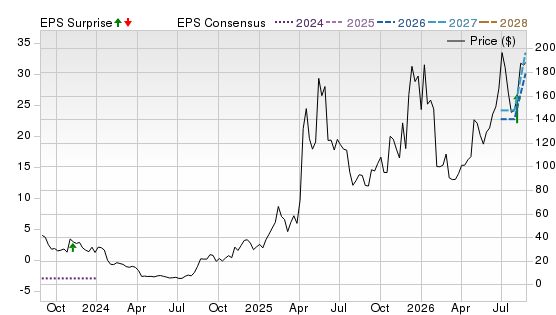
On the Price, Consensus & EPS Surprise chart, the stock’s multi-quarter base contrasts with rising 2025–27 consensus lines and several upside surprises. The slope of newer estimates turning higher after a long decline implies revision momentum that can bridge the value and growth appeal despite lagging technicals.
See more from Zacks Research for This Ticker
Normally $25 each - click below to receive one report FREE:
Fiverr International (FVRR)
$19.76 USD -0.21 (-1.05%)
3-Year Stock Price Performance
Premium Research for FVRR
- Zacks Rank
- Strong Buy 1
- Style Scores
C Value C Growth C Momentum B VGM
- Market Cap:$715.81 M
- Projected EPS Growth:21.85%
- Last Quarter EPS Growth:32.35%
- Last EPS Surprise:10.00%
- Next EPS Report date:Feb. 18, 2026
Our Take:
Fiverr operates a global marketplace for digital services, connecting freelancers and businesses, with a market cap of roughly $716 million. A Zacks Rank #1 captures improving earnings revisions. With Style Scores of C across Value, Growth and Momentum, the setup is balanced rather than aggressive. This is supported by disciplined cost control, a shift in mix toward higher-value “Pro” and subscriptions, and a strong buyback plan that signals confidence in cash generation.
Driven by upmarket initiatives, AI-related categories, spend per buyer and a richer mix of value-added services, revenue grew 8.3% to $107.9 million, and the adjusted EBITDA margin reached 22.4% in the last reported quarter.
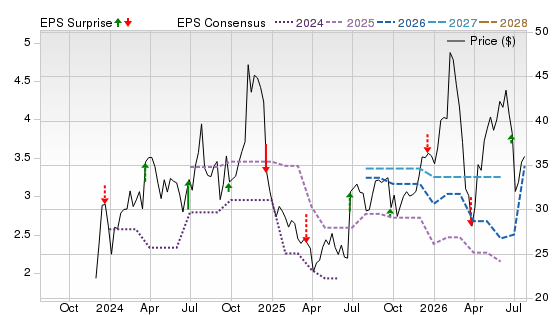
The chart shows estimates for 2025–27 drifting higher while price action has started to recover from last year’s lows. That spread, rising forward lines against a still-rebuilding share price, suggests upside if execution on take-rate expansion and marketing efficiency persists.
See more from Zacks Research for This Ticker
Normally $25 each - click below to receive one report FREE:
Rogers (ROG)
$94.26 USD +0.23 (0.24%)
3-Year Stock Price Performance
Premium Research for ROG
- Zacks Rank
- Strong Buy 1
- Style Scores
C Value C Growth D Momentum D VGM
- Market Cap:$1.69 B
- Projected EPS Growth:-22.06%
- Last Quarter EPS Growth:164.71%
- Last EPS Surprise:28.57%
- Next EPS Report date:Feb. 18, 2026
Our Take:
Rogers makes advanced materials used in EV and HEV, power electronics and RF applications, with a market cap near $1.7 billion. A Zacks Rank #1 underscores estimate revisions and improving operating margin from mix and cost actions, even as sales faced softer EV and portable-electronics demand. Style Scores of C for Value and Growth and D for Momentum indicate that revision strength outweighs valuation or momentum signals for now, consistent with a margin-recovery story.
Restructuring its German facility will boost savings, while new product launches aimed at thermal management can help offset demand fluctuations. The industrial market contributes the most to its total sales.
On the chart, shares have climbed while 2025–26 consensus moved steadily higher, reflecting better execution and operating leverage. The rising estimate curves versus earlier dips highlight incremental confidence that restructuring and pricing can sustain earnings as EV demand stabilizes and design wins convert.
See more from Zacks Research for This Ticker
Normally $25 each - click below to receive one report FREE:
Great Lakes Dredge & Dock (GLDD)
$13.34 USD -0.19 (-1.40%)
3-Year Stock Price Performance
Premium Research for GLDD
- Zacks Rank
- Strong Buy 1
- Style Scores
A Value A Growth F Momentum A VGM
- Market Cap:$920.03 M
- Projected EPS Growth:29.76%
- Last Quarter EPS Growth:85.71%
- Last EPS Surprise:52.94%
- Next EPS Report date:Feb. 17, 2026
Our Take:
Great Lakes is the largest U.S. dredging contractor focused on coastal protection and port deepening. Its market cap is around $920 million. A Zacks Rank #1 follows a strong backlog commentary, with management pointing to robust bid activity and fleet additions supporting utilization. Style Scores of A for Value and Growth reflect improved earnings power versus prior years, though F for Momentum lags amid upcoming drydockings that may create near-term noise.
In the last reported quarter, contract revenue increased, with higher profitability and a $1 billion backlog. It was supported by capital and coastal-protection work and LNG-related projects.
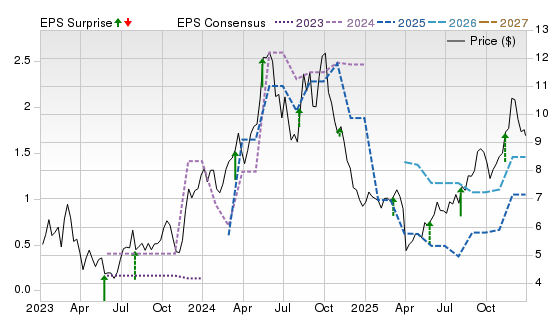
The chart shows estimates troughing for 2025 before recovering into 2026–27 while the stock consolidates gains from last year’s rebound. That pattern, stabilizing price against improving forward lines, fits a cyclical upturn narrative as project awards convert and newer hopper capacity ramps, reinforcing the Rank.
See more from Zacks Research for This Ticker
Normally $25 each - click below to receive one report FREE:
Heritage Insurance (HRTG)
$28.99 USD -0.79 (-2.65%)
3-Year Stock Price Performance
Premium Research for HRTG
- Zacks Rank
- Strong Buy 1
- Style Scores
A Value C Growth D Momentum A VGM
- Market Cap:$920.54 M
- Projected EPS Growth:155.72%
- Last Quarter EPS Growth:5.16%
- Last EPS Surprise:207.55%
- Next EPS Report date:March 10, 2026
Our Take:
Heritage is a super-regional property and casualty insurer concentrated in catastrophe-exposed states with a market cap of $920.54 million. A Zacks Rank #1 reflects estimate momentum supported by continued profitability from rate actions, underwriting improvements and prudent reinsurance, despite elevated catastrophe losses. Style Scores of A for Value balances D for Momentum and a mixed C for Growth, consistent with a rebuilding P&C earnings story supported by capital discipline.
Rate adequacy, portfolio diversification and quality customer service are major differentiators for the company, improving its policy count. It focuses on allocating funds to products and geographies that maximize returns over the long term.
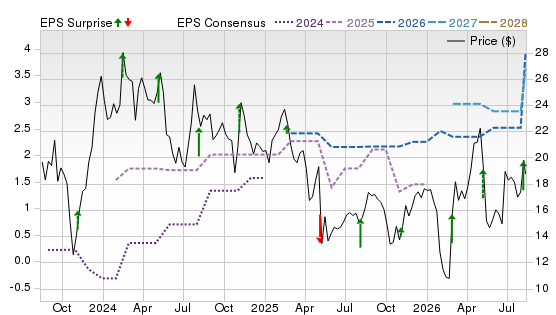
On the chart, the stock’s gradual uptrend aligns with 2025–27 consensus turning higher from a low base, suggesting improved confidence in normalized earnings power. While event risk remains inherent, rising forward estimates and recent upside surprises substantiate the valuation case.
See more from Zacks Research for This Ticker
Normally $25 each - click below to receive one report FREE:
Methodology
The Zacks Rank is a proprietary stock-rating model that uses trends in earnings estimate revisions and earnings-per-share (EPS) surprises to classify stocks into five groups: #1 (Strong Buy), #2 (Buy), #3 (Hold), #4 (Sell) and #5 (Strong Sell). The Zacks Rank is calculated through four primary factors related to earnings estimates: analysts' consensus on earnings estimate revisions, the magnitude of revision change, the upside potential and estimate surprise (or the degree in which earnings per share deviated from the previous quarter).
Zacks builds the data from 3,000 analysts at over 150 different brokerage firms. The average yearly gain for Zacks Rank #1 (Strong Buy) stocks is +23.62% per year from January, 1988, through June 2, 2025.
For this list, only companies trading 100,000 shares or more daily and in the top 50% of industries were considered. All stocks had a Zacks Rank #1 rank at the time of selection. All information is current as of market open, Dec. 26, 2025.
Guide to Best Small-Cap Stocks
What Are Small-Cap Stocks?
“Small-cap” refers to publicly traded companies whose market capitalisation falls below a certain threshold. The exact cutoff varies by region or index provider, but commonly in the U.S. small-caps are defined as roughly $300 million to $2 billion in market cap.
Why Invest in Small-Cap Stocks
- Growth potential: Because these companies are smaller, they have more runway to grow revenues, profits and market share.
- Diversification: They often behave differently than large-cap stocks, so including them can enhance portfolio diversification.
- Value opportunity: Many small-caps are currently trading at valuations below historical norms or relative to large caps — offering potential mispricing opportunities.
Small-Cap vs Mid-Cap vs Large-Cap Stocks
Small Cap:
- Market capitalization of between $300 million to $2 billion (but designation can vary among indices).
- Higher growth potential, but higher risk and less liquidity.
- More volatile and more sensitive to economic and interest rate shifts.
Medium (Mid) Cap:
- Market capitalization generally from $2 billion to $10 billion.
- Balanced between growth and stability.
- Fewer extremes than small caps, but possibly less upside.
Large Cap:
- Market cap is usually over $10 billion.
- Established companies, lower growth but more stability.
Benefits of Investing in Small-Cap Stocks
- Potential for outsized returns if a small company scales successfully.
- Greater market inefficiencies — less analyst coverage means more opportunity for undervalued gems.
- Cyclical upside — when conditions improve (such as lower rates or economic recovery) small caps often lead the trend.
Risks and Challenges of Small-Cap Stocks
- Higher volatility — More price swings, less predictable earnings.
- Sensitivity to economic and interest rate cycles — Small cap companies often carry more floating rate debt, shorter maturities, and weaker financials. Small cap stocks are generally “more vulnerable” in elevated-interest rate environments.
- Less liquidity and coverage — Small cap stocks may be harder to trade, with fewer analysts covering them and less public information
- Greater capital risk — Many small-cap firms are still unprofitable; their future may be less certain.
Small-Cap ETFs vs Small-Cap Stocks
- ETFs: Small-cap exchange traded funds provide instant diversification, lower company-specific risk, simpler to invest.
- Individual stocks: Offer higher potential upside (and higher risk). You can benefit from picking a breakout company, but the odds of mis-steps are higher.
- If you believe in the asset class broadly, a small-cap ETF may be a smarter choice; if you want to hand-pick potential winners and accept higher risk, then individual stocks might appeal.
How to Choose the Best Small-Cap Stocks
Look at factors like:
- Business quality: Profitability (or path to profitability), return on invested capital, competitive advantage (often known as a ‘moat”).
- Financial strength: Manageable debt, good cash flow and reasonable valuation.
- Valuation: Since small caps are currently trading at depressed valuations relative to large caps, finding ones that are both good quality and cheap may give you an edge.
- Sector and cycle fit: Because many small-caps are more cyclical, consider how economic or rate trends might affect them.
- Liquidity and transparency: Ensure the company has sufficient trading volume and good public disclosure.
- Time horizon: Small-cap investing often requires patience — these stocks may take time to execute and get recognised by the market.
How to Invest in Small-Cap Stocks
- Decide your allocation: How much of your portfolio are you willing to place into higher-risk small caps?
- Combined approach: Consider holding a small-cap ETF and a few hand-picked individual names for upside.
- Use dollar-cost averaging to smooth entry over time (given the greater volatility of small cap stocks.)
- Monitor macroeconomic variables: Interest rates, economic growth, inflation, liquidity — these matter for small caps.
- Stay disciplined: Set stop-losses or position limits; avoid over-allocating to speculative names
- Review your time horizon: Small caps typically work better when held for multiple years rather than trading in and out.
Tips for Building a Small-Cap Portfolio
- Diversify across sectors to avoid concentration risk (such as spreading across small-cap healthcare, industrial, consumer stocks and so forth).
- Blend quality and speculative: Have some “core” small-cap holdings with proven businesses plus some high-upside speculative names.
- Watch weighting: Don’t let any one small-cap issue become too big a part of your portfolio.
- Track valuations: Since small-cap valuations can re-rate, be ready to adjust when valuations seem stretched.
- Stay updated on macro shifts: For example, rate cuts can help small-caps more than large caps. Medium term, that dynamic could drive performance.
Frequently Asked Questions About Small-Cap Stocks
How long should I hold small-cap stocks?
Because of their risk and growth nature,a time horizon of 3-5 years or more is generally preferable. Short-term trading can be risky due to volatility and structural shifts.
Are small-cap stocks suitable for beginners?
They can be, but only if the investor understands the risks, is comfortable with volatility and uses appropriate position sizing. Beginners might start with ETFs or limit exposure rather than going heavy into speculative names.
What sectors do the best small-cap stocks usually come from?
Historically: industrials, consumer discretionary, healthcare/biotech, technology. Small caps tend to have more cyclical exposure compared to large caps.
Also note many small-caps fly under the radar.
Can small-cap stocks be dividend-paying?
Yes — though less commonly than large-caps. Many small-cap companies reinvest profits into growth rather than returning dividends. But some mature small-caps may pay dividends.
What is the historical performance of small-cap stocks?
- Historically small-caps offered a “small-cap premium” over large-caps due to greater growth potential.
- However, more recently this premium has eroded — for example, J.P. Morgan reports that the small-cap growth engine has diminished in recent years.
- Still, some data suggests that when macro conditions shift (such as interest rate cuts and economic recovery), small caps tend to outperform large caps.